
GoHighLevel works for an insurance agency as a speed-to-lead and policyholder-communication layer: it answers new inquiries within minutes, chases stalled quotes, welcomes new policyholders, runs renewal reminders, triggers cross-sell conversations and wins back lapsed policies. It is not an agency management system (AMS): it does not hold policy records, rate quotes, connect to carriers or track commissions. Every automated text and call has to be built around consent rules and each producer's state licensing, so those are part of the setup rather than an afterthought. This guide covers the lifecycle, the CRM setup, nine workflows, the compliance lines, cost and a 90-day rollout.
Short answers
- Good for insurance agencies? Yes, with consent capture and licensing routing built in from day one.
- Replaces my AMS, EZLynx, HawkSoft or AgencyBloc? No. Those hold policy data, rate quotes and track commissions.
- Biggest risk: texting without documented consent. Marketing texts need prior express written consent; build the record before the workflow.
- Cost: platform $97 to $497 a month plus usage; build quoted in writing.
Who this is for
- Independent agencies (property and casualty, life, health or multi-line) that handle their own lead intake.
- Owners who rely on producers to remember quote and renewal follow-up.
- Multi-producer or multi-location agencies that want one lead-response and renewal process.
- Agencies whose AMS sends reminders but who still lose quotes to slow follow-up.
The guide assumes inbound leads from the web, referrals, aggregators or paid sources, plus a renewal book that needs retention outreach. If your book is renewal-only, the speed-to-lead sections matter less.
- Weeks 1 to 2Setup, consent and routing
- Weeks 3 to 4Lead response and quotes
- Weeks 5 to 8Policyholders and renewals
- Weeks 9 to 12Growth and review
Source: the rollout plan described in this guide
The policyholder lifecycle and where GoHighLevel fits
| Stage | Trigger | What the automation does |
|---|---|---|
| 1. Inquiry to lead | Web form, call, aggregator or referral | Responds in minutes, records consent, sends a quote-intake form, routes to a licensed producer |
| 2. Quote requested to presented | Quote request or quote sent | Notifies the producer and follows up if the quote is not reviewed within a day or two |
| 3. Bound to onboarding | Policy bound | Welcome message, confirmation of documents, payment-schedule reminder |
| 4. Active policyholder: service and cross-sell | Ongoing or a life-event signal | Acknowledges service requests, flags bundling opportunities, texts back missed calls |
| 5. Renewal to retain or lapse | Sixty to ninety days before renewal | A multi-touch renewal sequence; a win-back sequence if the policy lapses |
The two moments with the highest leverage are the first minutes after an inquiry and the renewal window. Both get an automatic response instead of depending on a producer's memory.
GoHighLevel insurance agency CRM setup
| Piece | What to set up |
|---|---|
| Pipeline | New inquiry, quoted, bound, active policyholder, renewal, lapsed |
| Source tracking | Tag by origin (aggregator, referral, web form, cross-sell) to see which channels bind |
| Custom fields | Line of business, carrier, renewal date, assigned producer, consent status |
| Consent capture and log | A timestamped record of consent before any automated text goes to that contact |
| Licensing routing | Rules so a lead goes only to a producer licensed in the lead's state |
| Inbox | One thread per policyholder for texts, calls and email |
| Reporting | Response time, quote-to-bind conversion and renewal retention by stage |
Most DIY builds turn on a generic autoresponder without mapping consent and licensing first, which is exactly where regulatory exposure comes from.
Where agency revenue leaks
| Leak | Why it happens | What GoHighLevel does |
|---|---|---|
| Slow lead response | An inquiry waits for a producer who is on another call, and the prospect gets quotes from others | An instant reply and quote-intake form, with the lead routed to a licensed producer |
| Stalled quotes | A quote is sent and nobody follows up | A follow-up sequence and a task for the producer |
| Renewal leakage | A renewal that is not touched ahead of time can be shopped or can lapse | A reminder sequence from a set window before the renewal date |
| Missed cross-sell | A policyholder with one line is never asked about others | A trigger for single-line customers and life events such as a new home or vehicle |
Lead-response and conversion statistics for insurance are published mostly by lead vendors and vary by line and source, so we do not quote them. Measure your own: leads per month, minutes to first response, quotes sent, quotes bound and renewals retained.
Core insurance workflows: nine to build
| # | Workflow | Trigger | Sequence | Exit |
|---|---|---|---|---|
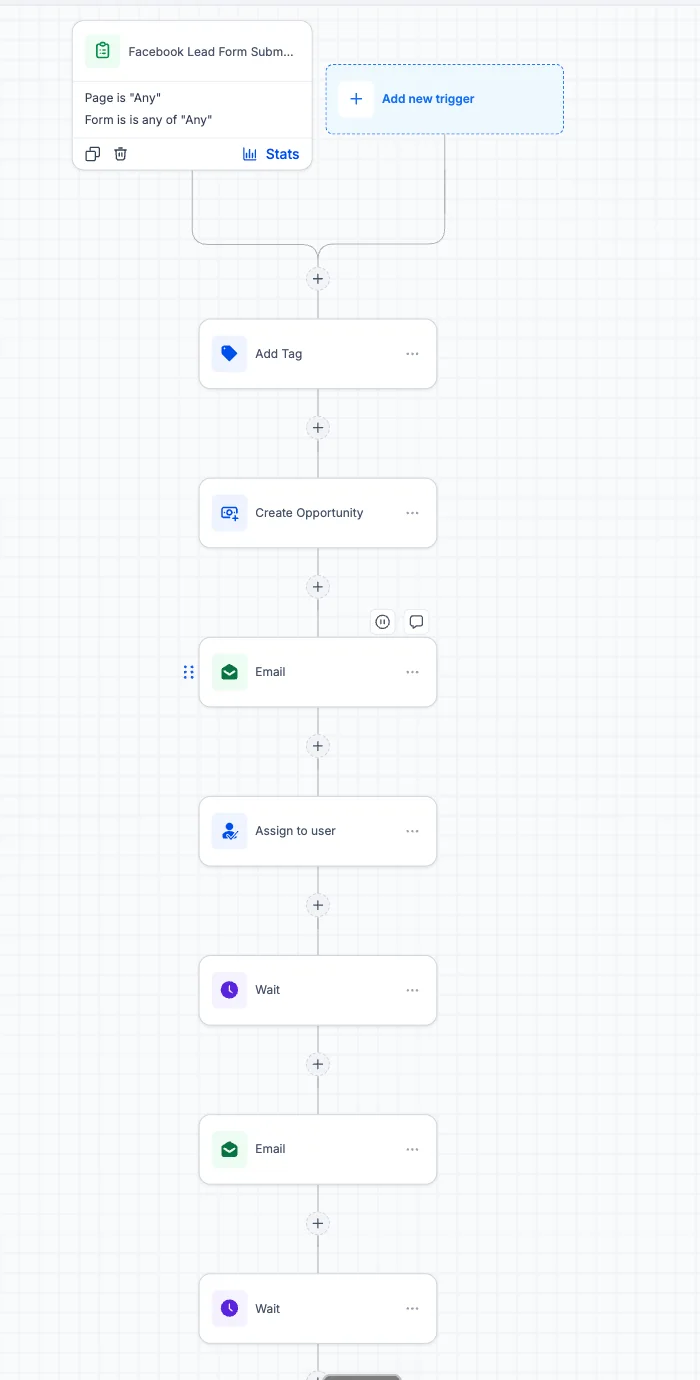
| 1 | Speed-to-lead response | New inquiry with consent | Instant text and email, quote-intake form, assign to a licensed producer, task for a live call | Contacted or quote started |
| 2 | Quote follow-up | Quote sent | Follow-up after a day, again after a few days, producer task if no reply | Bound or declined |
| 3 | New-policyholder welcome | Policy bound | Welcome, confirmation of documents, payment-schedule reminder, review request later | Sequence ends |
| 4 | Renewal reminders | Sixty to ninety days before renewal | Several touches by text and email, then a producer task for non-responders | Renewed or lapsed |
| 5 | Missed-call text-back | Inbound call unanswered | A text within seconds; logged as a lead or service request | Contact replies |
| 6 | Cross-sell trigger | Single line of business or a life-event field | Flag the account, notify the producer, send a bundling message | Conversation booked |
| 7 | Service-request acknowledgment | Service request submitted | Acknowledge, route to the right person, check in after resolution | Resolved |
| 8 | Review request | After bind or a good service interaction | Request by text or email, within what your state and carrier rules allow | Review link clicked |
| 9 | Lapsed-policy win-back | Policy lapsed | Several weeks of text, email and call task | Reinstated or closed |
Build 1, 2 and 4 first. They protect new business and the renewal book.
Consent, state licensing and E&O considerations
Insurance communication runs into regulation that a generic marketing setup does not account for. Build it into the CRM rather than adding it after launch, and have compliance counsel review it.
- TCPA consent. Marketing texts generally require prior express written consent; informational texts such as quote details or service reminders generally require prior express consent. The TCPA allows $500 per violation, and a court may raise that to up to three times the amount for willful violations (up to $1,500 at the base figure), so consent must be documented and timestamped.
- State rules beyond the federal law. Some states add their own limits on timing, consent and enforcement. Florida's telephone solicitation law, for example, requires prior express written consent for automated sales calls and texts and allows private lawsuits. Federal rules also limit solicitation calls to 8 a.m. to 9 p.m. in the recipient's local time. Build quiet hours by the contact's state.
- Producer licensing. People who sell, solicit or negotiate insurance must be licensed as producers, and state insurance regulators issue the licenses. Check each producer's resident and nonresident licenses and route leads by state, not by who is available.
- E&O coverage. Ask your errors-and-omissions carrier whether your automated communication practices fall within what the policy covers.
- Identification and opt-out. Automated messages should clearly identify your agency and include a working opt-out.
US texting also needs A2P registration, covered in A2P registration. This is an overview, not legal advice.
What GoHighLevel does and does not replace
| System | Replaced by GoHighLevel? |
|---|---|
| CRM and lead and policyholder communication | Yes |
| Speed-to-lead and quote follow-up automation | Yes |
| Renewal reminders and win-back campaigns | Yes |
| Review requests | Yes |
| Rating and comparative quoting | No |
| Agency management system, policy records and commissions | No |
| Carrier connections and real-time policy data | No |
| Claims processing | No |
GoHighLevel and agency software
AMS and rating tools price per user or per module and change often. Compare by function and confirm with each vendor.
| Function | GoHighLevel | Agency management and rating software |
|---|---|---|
| Rating and comparative quoting | No | Yes, in rating tools |
| Policy records and commission tracking | No | Yes, in an AMS |
| Lead response and quote follow-up | Core feature, fully configurable | Basic or an add-on |
| Renewal outreach | Fully configurable sequences | Reminders, often basic |
| Landing pages and funnels | Built in | Rarely included |
| Pricing model | Flat plan plus usage | Per user or module |
Verdict: GoHighLevel is not a competitor to your AMS or rating tool. It is the lead-response and communication layer next to them. Check how renewal dates and policy status will reach GoHighLevel, because that data lives in the AMS.
What GoHighLevel costs an insurance agency
| Item | Cost at the time of writing | Note |
|---|---|---|
| Platform | $97, $297 or $497 a month (HighLevel pricing) | See the pricing guide |
| Texts, calls, email | Usage-based | Scales with lead and policy count |
| Build | Basic setup $500 to $4,000; multi-location by custom quote after a free 30-minute call | See pricing |
To test the case, divide the monthly platform cost by the average annual premium commission on a policy to see how many extra bound or renewed policies it takes to break even, then compare with how many leads you answer late today and how many renewals you lose.
The 90-day rollout
- Weeks 1 to 2: setup, consent and routingAccount, A2P registration, consent capture, licensing routing, pipeline and fields.
- Weeks 3 to 4: lead response and quotesWorkflows 1, 2 and 5, tested with test contacts in different states.
- Weeks 5 to 8: policyholders and renewalsWorkflows 3, 4 and 7, with renewal dates imported from the AMS.
- Weeks 9 to 12: growth and reviewWorkflows 6, 8 and 9, then audit consent records and tune messages.
When GoHighLevel is and is not a good fit
| Good fit | Poor fit |
|---|---|
| Inbound leads that need fast follow-up | You need rating, an AMS or carrier connections from one tool |
| Producers follow up on quotes and renewals from memory | Your book is renewal-only with no new business |
| A renewal book with no systematic outreach | You will not capture and keep consent records |
| You want one view of every conversation | No one will own the workflows and compliance review |
Sources and further reading
Checked at the time of writing; prices, features and policies change. Checked 2026-10-19.
- HighLevel pricing page: $97, $297 and $497 plans, unlimited contacts, usage-based charges (read 2026-10-19)
- 47 CFR 64.1200 (FCC delivery restrictions): prior express written consent for autodialed marketing calls and texts, prior express consent otherwise, 8 a.m. to 9 p.m. calling hours
- 47 U.S.C. 227 (TCPA): private right of action, $500 per violation, up to three times that for willful violations
- Florida Statutes 501.059: telephone solicitation (written consent for automated sales calls and texts, private right of action)
- NAIC: producer licensing (state insurance regulators license producers)
- HighLevel: US Phone Number Registrations (A2P 10DLC required for US texts from standard local numbers)
Frequently asked questions about GoHighLevel for insurance agencies
Is GoHighLevel good for insurance agencies?
Yes, for lead response, quote follow-up, renewal reminders and cross-sell, provided consent capture and state licensing routing are built in from the start. It is not an agency management system.
Will it replace my AMS or EZLynx, HawkSoft or AgencyBloc?
No, it does not rate quotes, hold policy records, connect to carriers or track commissions. It sits next to your AMS and handles communication, using renewal dates and policy status that you pass in.
Do I need consent to text insurance leads?
Yes, marketing texts generally require prior express written consent, and informational texts generally require prior express consent. Capture and timestamp it, and only enrol those contacts in text workflows. Some states add stricter rules.
How does GoHighLevel handle producer licensing?
GoHighLevel does not know producer licenses by itself. You record each producer's licensed states in a field and build routing rules, so a lead from a given state goes only to a licensed producer. The rules are only as accurate as the data you maintain.
How much does GoHighLevel cost for an insurance agency?
The platform is $97, $297 or $497 a month at the time of writing, plus usage for texts, calls and email. Basic setup runs $500 to $4,000, white label $3,500 to $5,000, and multi-location work is a custom quote after a free 30-minute call. See the pricing page.
Can it help with renewals?
Yes, a sequence starts a set number of days before each renewal date and runs several touches by text and email, then creates a task for a producer if the policyholder does not respond. It depends on renewal dates being current in the CRM.
Can it automate cross-selling?
It can flag policyholders with a single line of business or a life-event signal and prompt a bundling conversation, but a producer should have the conversation. The signal fields need to come from your AMS or your own intake.
How long does an agency setup take?
A scoped build typically takes a few weeks to get lead response and quote follow-up live, with the full rollout over about 90 days. Consent capture and importing renewal data are the steps that most often add time.
Related guides
- GoHighLevel for law firms: another consent-sensitive intake model
- GoHighLevel for real estate agents: speed-to-lead model
- A2P registration rejected
- GoHighLevel setup guide
- GoHighLevel pricing