
GoHighLevel works for a dental practice as the patient-communication and recall layer: it answers new-patient inquiries in minutes, sends appointment reminders, recovers no-shows, follows up on treatment plans that were not scheduled, keeps hygiene patients on recall and wins back lapsed patients. It sits beside your practice-management system and does not replace clinical charting, imaging or insurance billing. Whether it pays for itself depends on your patient volume, no-show rate, case-acceptance rate and the quality of the build. This guide covers the lifecycle, the nine workflows to build, the HIPAA decisions, the cost and a 90-day rollout.
Short answers
- Good for dental practices? Yes for reminders, no-show recovery, treatment-plan follow-up, hygiene recall and reactivation. Weaker for single-visit specialty practices with no recurring recall.
- Replaces Dentrix or your practice-management software? No.
- HIPAA? HIPAA add-on ($297 a month at the time of writing) and a signed BAA before patient information goes in. See the HIPAA page.
- Cost? Platform $97 to $497 a month plus usage; build quoted in writing.
Who this is for
- Solo general dentists running their own front desk and recall.
- Multi-provider practices with an office manager coordinating communication.
- Multi-location groups that want one recall and reactivation system across offices, using a shared snapshot per site.
- Practices whose management software sends reminders but still sees no-shows and hygiene recall drop off.
The guide assumes a general or family practice with a recurring hygiene cadence and restorative treatment planning. If your practice is single-visit and referral-based, such as oral surgery, the hygiene sections matter less and the new-patient and referral-source sections matter more.
- Weeks 1 to 2Setup and HIPAA
- Weeks 3 to 4Reminders and no-shows
- Weeks 5 to 8Treatment plans and recall
- Weeks 9 to 12Reviews, missed calls, benefits
Source: the rollout plan described in this guide
The dental patient lifecycle and where GoHighLevel fits
| Stage | Trigger | What the automation does |
|---|---|---|
| 1. Inquiry to new-patient exam | Web form, call, insurance-directory inquiry or referral | Texts within minutes, sends intake and health-history forms, offers exam times |
| 2. Exam to treatment plan presented | Exam done, plan proposed | Sends a summary and financing or benefit reminder; follows up if the plan is not scheduled within a set window |
| 3. Treatment accepted to active treatment | First procedure scheduled | Reminders for each visit; flags missed visits for staff |
| 4. Treatment complete to hygiene recall | Patient moves to a 3-, 4- or 6-month cadence | Recall reminders at the recommended interval with a booking link |
| 5. Lapsed to reactivation | Overdue by your defined window | A timed sequence with a specific reason to return; stops on booking |
The two moments with the highest leverage are a missed visit and an unscheduled treatment plan. Both trigger an immediate, automatic response rather than silently becoming lost production.
GoHighLevel dental CRM setup
| Piece | What to set up |
|---|---|
| Pipeline | New inquiry, exam booked, treatment plan presented, active treatment, hygiene recall, lapsed or reactivation |
| Source tracking | Tag by origin (referral, web form, insurance directory, walk-in) to see which channels convert |
| Custom fields | Treatment-plan status and value, hygiene interval, last-visit date, insurance or self-pay |
| Calendars | Separate booking types for new-patient exams, hygiene and restorative visits, each with its own reminders |
| HIPAA | BAA signed and HIPAA mode on before any workflow that touches patient information goes live |
| Inbox | A single thread per patient for texts, calls and email |
| Reporting | No-show rate, case acceptance and recall or reactivation conversion by stage |
Most DIY builds stop at appointment reminders and skip the pipeline and compliance structure, which is why they stall.
Where dental revenue leaks
| Leak | Why it happens | What GoHighLevel does |
|---|---|---|
| No-shows and last-minute cancellations | Single or no reminders; no immediate follow-up on a missed visit | Confirmation, day-before and same-day reminders; a same-day reschedule message when a visit is missed |
| Treatment plans that are never scheduled | The patient leaves without booking and nobody follows up | Flags the plan and starts a follow-up with financing or benefit information, then a staff task |
| Lapsed hygiene patients | Recall depends on the patient calling | Reminders at the recommended interval, then reactivation when overdue |
Published no-show and case-acceptance averages mostly come from dental software vendors and vary by source and method, so we do not quote them. Work out your own: appointments per month, missed and cancelled share, how many presented plans get scheduled, and how many active patients are overdue for hygiene.
Core dental workflows: nine to build
| # | Workflow | Trigger | Sequence | Exit |
|---|---|---|---|---|
| 1 | New-patient speed to response | Form, call or referral | Text within minutes, send intake and health-history forms, offer exam times | Exam booked |
| 2 | Appointment reminders | Appointment booked | Confirmation, 24-hour and same-day reminders | Appointment ends or cancelled |
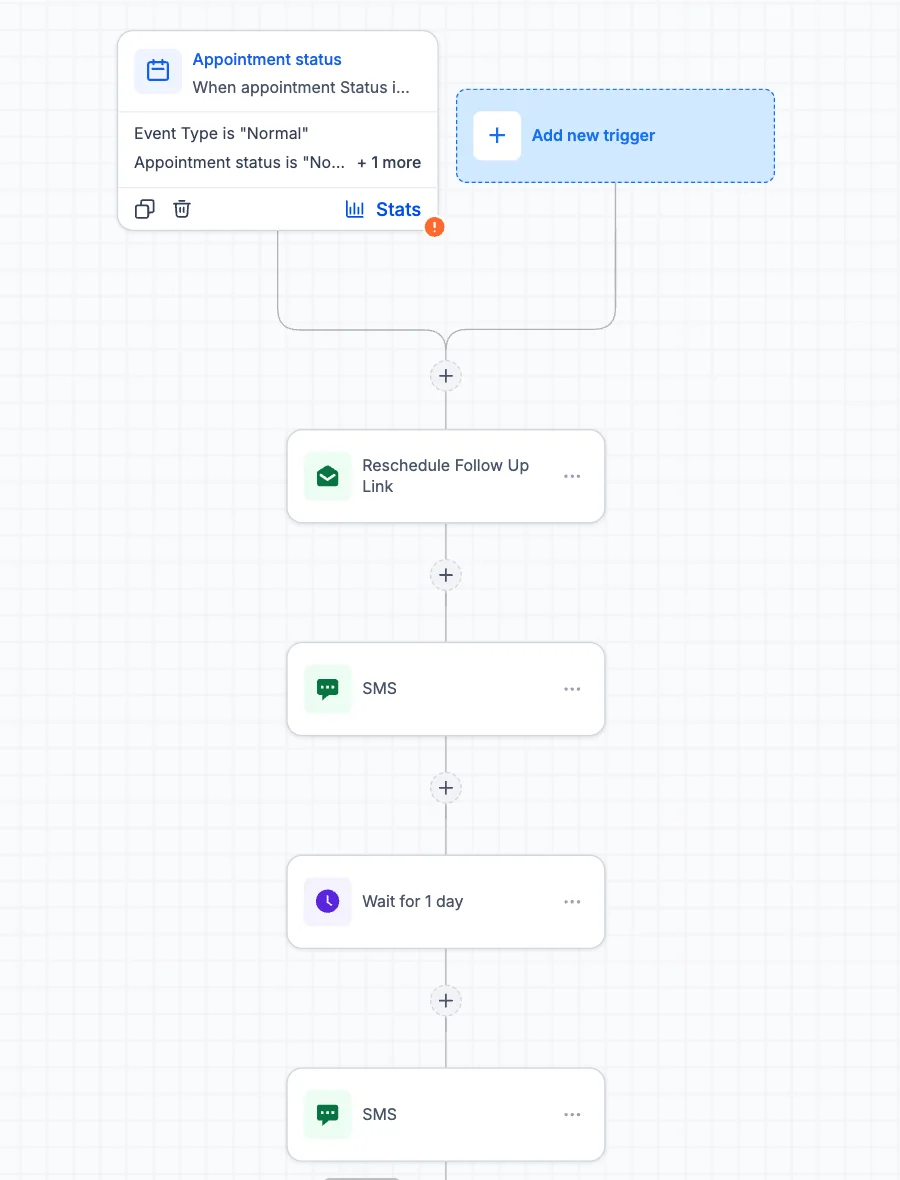
| 3 | No-show and cancellation recovery | Marked no-show or late cancel | Same-day reschedule text, next available slot, staff callback after 24 hours | Rebooked |
| 4 | Treatment-plan follow-up | Plan presented, not scheduled in a set window (for example 7 days) | Flag, send financing or benefit info, create a staff task | Scheduled or declined |
| 5 | Hygiene recall | Patient nears the recommended interval | Reminders and a booking link; call task if not booked | Booked |
| 6 | Lapsed-patient reactivation | Overdue past your window | Several weeks of text, email and a call task with a specific reason to return | Rebooked |
| 7 | Review request | Completed visit or treatment milestone | Request by text or email; low-satisfaction replies go to staff privately | Review link clicked |
| 8 | Missed-call text-back | Inbound call unanswered | A text within seconds; logged as a lead or an existing-patient inquiry | Contact replies |
| 9 | Insurance benefits reminder | Benefit period nearing its end | Remind of unused benefits and offer remaining covered visits | Booked |
Build in order: workflows 1 to 3 protect existing revenue, 4 to 6 grow it and 7 to 9 close the edges. For workflow 9, store the actual benefit end date per patient; many plans run on the calendar year but not all.
HIPAA and communication compliance
HighLevel's own help article says accounts are not HIPAA compliant by default. To put protected health information through it, a practice needs the HIPAA add-on ($297 a month at the time of writing, per HighLevel's pricing page), a signed BAA and a map of which workflows touch patient information.
Not every message is a HIPAA communication. General marketing that is unconnected to treatment, such as holiday-hours notices, may not be. Appointment reminders, treatment-plan details and anything naming a patient's diagnosis or procedure generally are. Whether a specific message counts is fact-specific; confirm with a healthcare attorney before going live. This is general information, not legal advice. Text consent and registration also apply: HighLevel says A2P registration is required when sending SMS or MMS to US recipients, and see A2P registration.
What GoHighLevel does and does not replace
| System | Replaced by GoHighLevel? |
|---|---|
| Patient contact management and CRM | Yes |
| Appointment reminders and no-show recovery | Yes |
| Hygiene recall and reactivation campaigns | Yes |
| Review requests | Yes |
| Dental practice-management and clinical charting | No |
| Perio charting and treatment documentation | No |
| Insurance eligibility and claims | No |
| X-ray and imaging | No |
| Phone system hardware and call analytics | Partly: GoHighLevel has calling, but dedicated dental phone systems are built around the hardware |
GoHighLevel and dental communication software
Dental practices often already use a patient-communication product alongside their management software. Compare by function, because plans, prices and integrations differ by tier and change; confirm with each vendor.
| Function | GoHighLevel | Dental communication or engagement tools |
|---|---|---|
| Clinical charting and claims | No | No |
| Reminders, recall and reactivation | Fully configurable | Core feature, often with prebuilt templates |
| Integration with your management software | Depends on what that software exposes; may need Zapier, webhooks or import | Often prebuilt for popular dental systems |
| Phone system integration | Calling built in, not hardware-native | Some are built around phone hardware |
| Online scheduling and digital forms | Built in | Core feature in many |
| Landing pages and funnels | Built in | Rarely included |
Verdict: GoHighLevel is not a competitor to your clinical software. It is the communication and recall layer, and it adds marketing capability that most dental tools lack. The tradeoff is that prebuilt dental integrations are narrower, so check how your software will feed appointment status and recall dates before you commit.
What GoHighLevel costs a dental practice
| Item | Cost at the time of writing | Note |
|---|---|---|
| Platform | $97, $297 or $497 a month (HighLevel pricing) | Single-location practices usually need Starter or Unlimited; see the pricing guide |
| HIPAA add-on | $297 a month | Account-wide |
| Texts, calls, email | Calls and texts are billed by use per HighLevel's phone billing guide; check email billing in your account | Scales with patient count and message volume |
| Build | Basic setup $500 to $4,000; multi-location by custom quote after a free 30-minute call | See pricing |
To judge the return, compare the monthly platform and HIPAA cost with what you recover: missed visits rebooked, treatment plans scheduled, overdue hygiene patients returned. For example, if a hygiene visit is worth a known amount to you, divide the monthly cost by that amount to see how many recovered visits it takes to break even.
The 90-day rollout
- Weeks 1 to 2: setup and HIPAAAccount, HIPAA add-on and BAA, patient import, pipeline and calendars for exams, hygiene and restorative.
- Weeks 3 to 4: reminders and no-showsWorkflows 1 to 3, tested on a subset of appointments before full rollout.
- Weeks 5 to 8: treatment plans and recallWorkflows 4 to 6, then launch to the active patient base.
- Weeks 9 to 12: reviews, missed calls, benefitsWorkflows 7 to 9, then review the data and refine messages; train the front desk on exceptions.
GoHighLevel for dentists: when it is and is not a good fit
| Good fit | Poor fit |
|---|---|
| General or family practice with recurring hygiene and restorative planning | Single-visit referral practice with little recall |
| No systematic reminder sequence today | Integrated phone hardware is your main requirement |
| A base of overdue or lapsed patients with no recall system | You are not ready to set up HIPAA before launch |
| You pay for several separate reminder, review and marketing tools | No one will own the workflows afterward |
Related: dental no show recovery and dental recall automation.
Sources and further reading
Checked at the time of writing; prices, features and policies change. Checked 2026-10-19.
- HighLevel: HIPAA Compliance With HighLevel (help article, modified June 11, 2026): accounts are not HIPAA compliant by default; the $297 a month add-on includes a signed BAA with the agency; the add-on cannot be cancelled or refunded once purchased
- HighLevel pricing page: Starter $97, Unlimited $297 and Agency Pro $497 a month, HIPAA add-on $297 a month, unlimited contacts and users on all plans
- HighLevel: US phone number registrations (A2P 10DLC): registration is required when sending SMS or MMS to US recipients
- HighLevel: Appointment Status workflow trigger
- HighLevel: Custom Date Reminder workflow trigger
- HighLevel: LC Phone pricing and billing guide
- HHS: HIPAA for professionals, compliance and enforcement
Frequently asked questions about GoHighLevel for dental practices
Is GoHighLevel good for dental practices?
Yes, for practices that want automated reminders, no-show recovery, treatment-plan follow-up and hygiene recall in one system. It is a weaker fit for single-visit referral practices with no recurring recall.
Is GoHighLevel HIPAA compliant for a dental practice?
Not by default, as HighLevel's own help article states. With the $297-a-month add-on, a signed BAA and HIPAA enabled on the sub-account it can be part of a compliant program. The practice still needs its own consent, access and message-content rules.
Will this replace Dentrix or my practice-management software?
No, GoHighLevel is the communication and recall layer on top. It does not do clinical charting, insurance claims or imaging, so your management software remains the system of record.
How does GoHighLevel compare to dental communication tools like Weave or Solutionreach?
Dedicated dental tools often have prebuilt integrations and templates, and some are built around phone hardware. GoHighLevel is more configurable and adds funnels and marketing, but its dental integrations are narrower. Compare current features and prices with each vendor.
How much does GoHighLevel cost for a dental practice?
The platform is $97, $297 or $497 a month at the time of writing, plus usage, plus $297 a month if you route patient information through it. Basic setup runs $500 to $4,000, white label $3,500 to $5,000, and multi-location work is a custom quote after a free 30-minute call. See the pricing page.
Can GoHighLevel improve case acceptance?
It automates follow-up on plans that were not scheduled, which is the mechanical gap most practices leave open. Case acceptance also depends on chairside presentation and financing options, which the software does not control.
Can GoHighLevel reduce no-shows?
Multi-touch reminders and a same-day reschedule message reduce missed visits compared with one reminder or none. The size of the effect depends on your patients and your baseline, so measure your no-show rate before and after.
What if a patient's messages contain health information?
Treat any workflow that references a specific patient's diagnosis, procedure or treatment plan as handling protected health information, and run it in a HIPAA-enabled account with a signed BAA. Confirm the classification of your workflows with a healthcare attorney.
Do we need a separate texting or reminder tool if we use GoHighLevel?
Usually no, GoHighLevel covers reminders, recall, reactivation and review requests, so many practices can drop one or two point tools. Keep your software's reminders only if it is the master schedule and you want one source for appointment times.
How long does a dental setup take?
A scoped build usually takes a few weeks to get the first three workflows live, with the full rollout over about 90 days. Importing patient data and setting up HIPAA are the steps that most often add time.
Related guides
- GoHighLevel for chiropractors: a related recall model
- GoHighLevel for med spas: rebooking and membership model
- Is GoHighLevel HIPAA compliant?
- GoHighLevel setup guide
- GoHighLevel pricing