
GoHighLevel for HVAC Contractors: Lead Response, Appointment Automation & No-Show Recovery
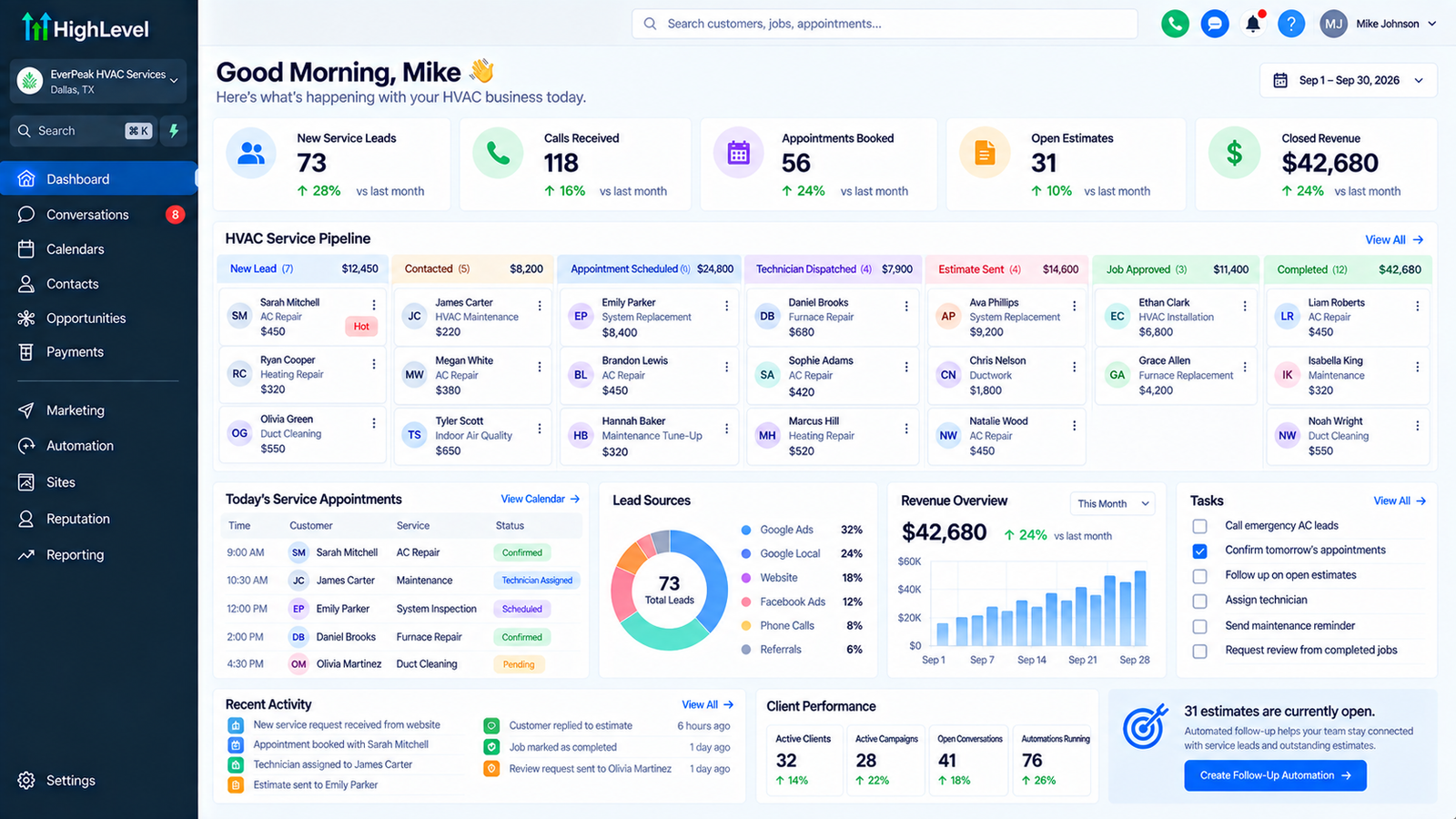
A GoHighLevel pipeline built for HVAC — jobs move automatically from New Lead through Scheduled, Dispatched, Completed, and Maintenance Plan.
Yes. GoHighLevel automates the lead-response and appointment layer of an HVAC business — instant lead response, appointment reminders, no-show recovery, missed-call recovery, review requests, and seasonal maintenance outreach — while consolidating tools most contractors currently pay for separately.
Short answer: GoHighLevel works as a lead-response and scheduling CRM for HVAC contractors — instant text-back, multi-touch appointment reminders, and no-show recovery in one system. It is a communication and CRM layer, not a replacement for field-service dispatch/routing software. See what GoHighLevel does and doesn’t replace below.
Whether it produces positive ROI depends on your call volume, current response time, and baseline no-show rate. This guide covers the lead-response math, HVAC CRM setup, the core automation workflows to build, seasonal maintenance-plan automation, what it actually costs, and the exact 30-day rollout — based on systems we have configured for home-service businesses across North America. If you’re deciding whether to DIY or hand it to an expert, our done-for-you GoHighLevel setup service covers the implementation at the end.
What’s in This Guide
- Who This Guide Is For
- The HVAC Job Lifecycle & Where GHL Fits
- GoHighLevel HVAC CRM Setup
- The Revenue Problem: Lost Leads, No-Shows & Missed Maintenance Revenue
- Core HVAC Workflows (9 Automations Every Contractor Needs)
- Seasonal Maintenance Plan Automation
- What GoHighLevel Does & Doesn’t Replace
- What Automation Actually Changes: Results Data
- GoHighLevel vs. HVAC Software (ServiceTitan, Housecall Pro, FieldEdge)
- Cost, ROI & Break-Even Math
- Implementation Roadmap & 30-Day Launch
- FAQ
- When GHL Is & Isn’t a Good Fit
Key Takeaways
- [Industry benchmark] HVAC contractors commonly lose an estimated 15-20% of inbound leads to slow response time — response speed is one of the largest controllable factors in close rate for home-service leads.
- [Industry benchmark] Appointment no-shows cost the average HVAC contractor an estimated $150-$300 per missed job at an 8-12% baseline no-show rate — calculate your own baseline rather than assuming this range.
- [HAT implementation observation] A single automated reminder reduces no-shows meaningfully; multi-touch reminders (confirmation, 24-hour, day-of) perform better than a single reminder — see the full no-show recovery workflow.
- [Verified pricing, Sept 2026] GoHighLevel’s $97-$497/month plans cover unlimited contacts, making it cost-effective versus per-tech licensing models common in HVAC-specific software once a shop has 3+ techs.
Who This Guide Is For
This guide is designed for:
- Independent HVAC contractors (1-5 techs)
- HVAC franchise owners with local operations
- Plumbing + HVAC or electrical + HVAC multi-trade contractors
- Shops currently using paper scheduling or a fragmented phone/text system
This guide assumes you handle residential service calls, not primarily commercial design/build work. See our real estate lead-response model for a comparable speed-to-lead framework in a different vertical, or the full GoHighLevel setup guide for a general-purpose walkthrough.
The HVAC Job Lifecycle & Where GHL Fits
An HVAC contractor runs each job through predictable stages — GHL’s job is to automate communication and scheduling at each one.
The Five-Stage Lifecycle:
Stage 1: Inbound Call → Lead Captured
- Trigger: Phone call, web form, or missed call
- GHL Role: Instant response and appointment booking
- Automation: Auto-text within seconds confirming receipt and offering booking times
Stage 2: Appointment Scheduled → Tech Dispatched
- Trigger: Appointment booked
- GHL Role: Confirmation, reminders, and tech notification
- Automation: Auto-send customer confirmation + map link; auto-alert tech with job details
Stage 3: Service Visit → Job Completed
- Trigger: Tech marks job complete
- GHL Role: Trigger invoicing and post-service follow-up
- Automation: Auto-send invoice/payment link and satisfaction survey
Stage 4: Post-Service → Review & Upsell
- Trigger: Positive service outcome
- GHL Role: Request a review and offer a maintenance plan
- Automation: Auto-send review request; auto-offer annual maintenance plan
Stage 5: Maintenance Plan → Seasonal Recall
- Trigger: Seasonal change (spring AC check, fall furnace tune-up)
- GHL Role: Keep maintenance customers on a recurring service cadence
- Automation: Auto-send seasonal booking reminders to the maintenance-plan list
The result: Every lead gets an instant response, every appointment gets multi-touch reminders, and maintenance customers get recurring seasonal outreach — without office staff managing it manually.
GoHighLevel HVAC CRM Setup
Before building automations, the CRM needs to be structured around how an HVAC business actually runs — not GHL’s generic default setup. A proper setup covers:
- Pipeline configuration — Custom stages: New Lead, Scheduled, Dispatched, Completed, Maintenance Plan
- Job type tagging — Emergency vs. routine vs. maintenance, so each type gets the right reminder cadence
- Custom fields — Equipment type/age, service area, maintenance-plan status — the data that drives seasonal outreach
- Calendar setup — Separate booking types for emergency calls (faster reminder cadence) vs. routine service
- Conversation settings — Shared inbox so dispatch and office staff see the full customer history
- Reporting dashboard — Lead response time, no-show rate, and maintenance-plan conversion tracked by stage
This setup layer is what most DIY builds skip — they turn on basic reminders without first structuring job-type-specific sequences, which limits how much of the no-show and lead-loss opportunity actually gets captured.
The Revenue Problem: Lost Leads, No-Shows & Missed Maintenance Revenue
Leak #1: Lost Inbound Leads (The Biggest Leak)
The math: A 5-tech crew doing 10-15 jobs/week at $400-$800/job generates $4,000-$12,000/week. If slow response causes a 15-20% lead-loss rate, that’s a meaningful share of weekly revenue lost to competitors who answer faster.
GHL fixes this: An inbound call or form is auto-answered within seconds — before the tech has even seen a notification.
Leak #2: Appointment No-Shows
The math: At a 10% no-show rate on 15 jobs/week and $500/job, that’s roughly 1.5 lost jobs/week — a recurring, calculable drain on weekly revenue.
GHL fixes this: A confirmation, 24-hour reminder, and same-day reminder sequence catches most no-shows before they happen.
Leak #3: Missed Seasonal & Maintenance Revenue
The math: Customers forget about seasonal HVAC service unless reminded — a maintenance-plan customer base with no systematic seasonal outreach silently loses repeat visits every year.
GHL fixes this: Automated seasonal reminders (“spring AC check,” “fall furnace tune-up”) capture recurring revenue that would otherwise be missed.
Core HVAC Workflows: 9 Automations Every Contractor Needs
Workflow 1: Instant Lead Response
Trigger: Phone call or web form submission
Sequence:
- Auto-text within seconds confirming receipt and asking emergency vs. routine
- If emergency: auto-offer the next available slot immediately
- If routine: auto-send online scheduling link with available times
Captures leads that would otherwise go to a faster-responding competitor
Workflow 2: Appointment Confirmation & Tech Dispatch
Trigger: Appointment booked
Sequence:
- Auto-send customer confirmation with tech name/photo and map link
- Auto-alert the assigned tech with job details and customer notes
Reduces confusion and last-minute cancellations
Workflow 3: Multi-Touch Pre-Appointment Reminders
Trigger: Appointment scheduled
Sequence:
- 24-hour reminder with confirm/reschedule option
- 2-hour “tech en route” notification
Directly targets the no-show leak above
Workflow 4: Post-Service Review Request
Trigger: Job marked complete
Sequence:
- Auto-send satisfaction survey within hours of completion
- Auto-request a Google review from satisfied customers
- Auto-flag low-satisfaction responses for manager follow-up instead of a public ask
Builds local search visibility without manual staff effort
Workflow 5: Maintenance Plan Upsell
Trigger: Repair job completed
Sequence:
- Auto-send maintenance-plan offer with savings framing
- Auto-follow up with a limited-time incentive if not converted
Converts one-off repairs into recurring maintenance revenue
Workflow 6: Missed-Call Text-Back
Trigger: Inbound call goes unanswered
Sequence:
- Auto-text within seconds: “Sorry we missed your call — how can we help?”
- Auto-log as a new lead or existing-customer inquiry
Recovers inquiries that would otherwise go to voicemail
Workflow 7: Invoice & Payment Follow-Up
Trigger: Service completed
Sequence:
- Auto-send itemized invoice with payment link
- Auto-remind if unpaid after 24 hours, then again at 30 days
Reduces accounts-receivable follow-up time
Workflow 8: Seasonal Maintenance Reminder
Trigger: Scheduled maintenance due date (6/12/24 months)
Sequence:
- Auto-send seasonal booking reminder (“spring AC check”)
- Auto-escalate to a call if not booked after 2-4 weeks
- Auto-offer a seasonal incentive to book
Directly targets the missed maintenance-revenue leak above
Workflow 9: Lapsed Customer Win-Back
Trigger: No service in 12+ months
Sequence:
- Auto-send a “we miss you” message with an inspection offer
- Multi-touch over several weeks
Recovers a share of dormant customers with no manual outreach
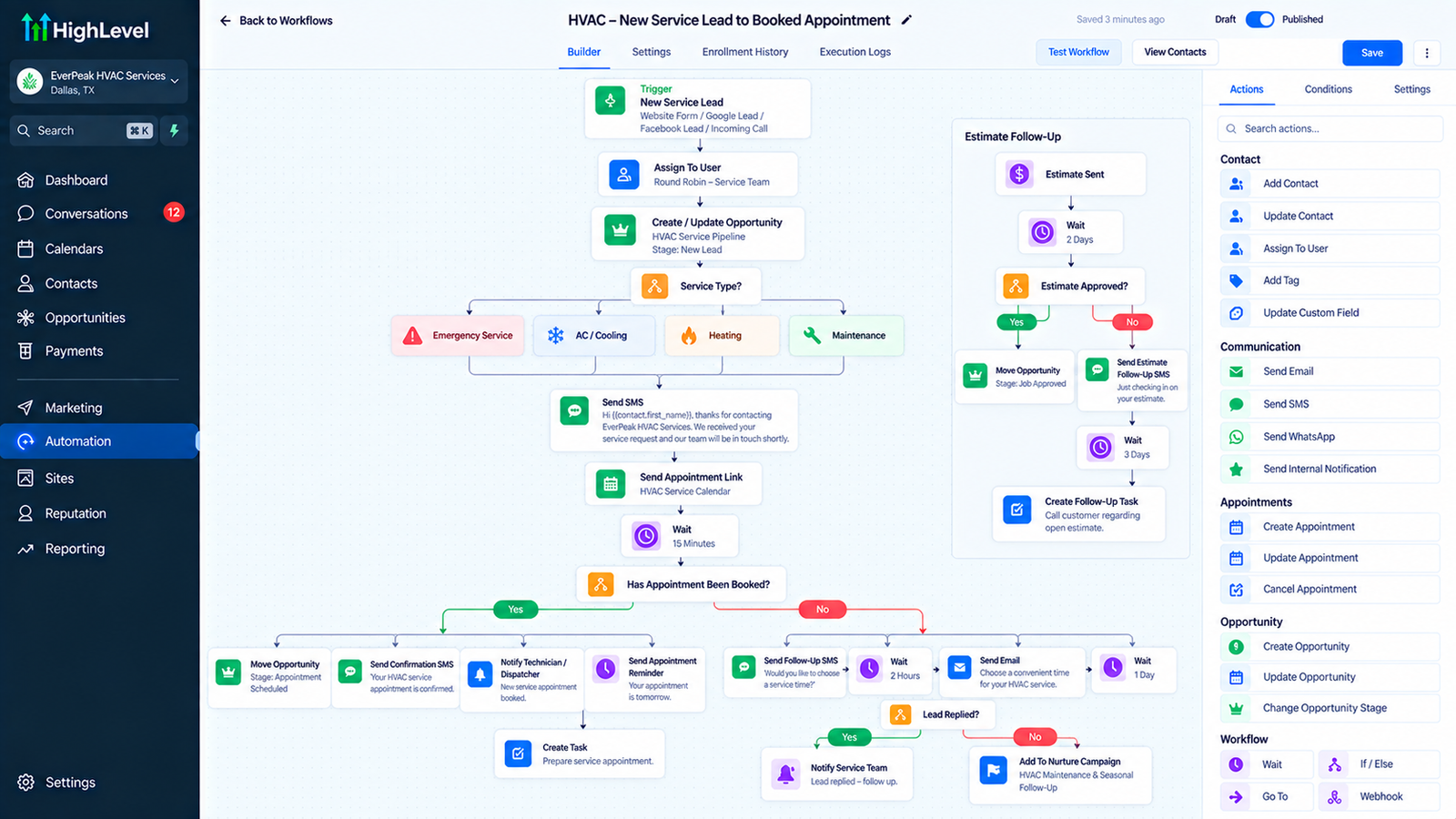
A dispatch-to-review workflow: appointment booking triggers tech notification, reminders, post-service invoicing, and a review request.
Seasonal Maintenance Plan Automation
Seasonal recall is where HVAC economics diverge from a typical service business — maintenance-plan customers generate predictable, recurring revenue if the outreach is systematic:
- Spring AC check reminders — Auto-triggered 6-8 weeks ahead of peak cooling season
- Fall furnace tune-up reminders — Auto-triggered ahead of heating season
- Filter replacement reminders — Recurring reminders based on equipment type
- Benefit-usage tracking — For plan members with included visits, tracking usage so unused benefits don’t quietly expire unnoticed
What GoHighLevel Does & Doesn’t Replace
GoHighLevel handles lead capture, scheduling communication, reminders, and reviews — but it doesn’t replace every system an HVAC business runs on. Being clear about this upfront avoids the most common source of buyer confusion:
| System | Does GHL Replace It? |
|---|---|
| CRM / lead & customer management | Yes |
| Appointment reminders & no-show recovery | Yes |
| Review requests | Yes |
| Seasonal maintenance outreach | Yes |
| Advanced route optimization / multi-tech dispatch | No — basic dispatch only; integrates with ServiceTitan/Housecall Pro via Zapier for advanced routing |
| Field inventory / parts management | No |
| Accounting / payroll | No |
What Automation Actually Changes: Results Data
[HAT implementation observations] Aggregate patterns we see across HVAC and home-service GoHighLevel implementations — illustrative ranges based on client configurations, not guaranteed results. Every shop’s baseline differs:
Real client result: Michael’s HVAC business, implemented 6 months ago, saw a 120% increase in business alongside Google reviews growing from 32 to 105 total through automated lead response, appointment reminders, and review requests.
GoHighLevel vs. HVAC Software (ServiceTitan, Housecall Pro, FieldEdge)
Monthly Cost Comparison — 5-Tech Shop
Entry-tier or estimated pricing shown at 5-tech scale; ServiceTitan and FieldEdge typically require a custom quote. GHL does not include advanced route optimization — see the feature table below.
| Feature | GoHighLevel | ServiceTitan | Housecall Pro | FieldEdge |
|---|---|---|---|---|
| Leads Capture & CRM | Built-in | Built-in | Built-in | Built-in |
| SMS/Text | Built-in (usage) | Add-on | Built-in | Add-on |
| Automated Reminders | Advanced (9+ workflows) | Limited | Limited | Limited |
| Tech Dispatch & Routing | Basic (manual) | Advanced | Good | Advanced |
| Review Management | Built-in | Limited | Limited | Limited |
| Best For | Lead capture, reminders, reviews at low cost | Full-service field management, large teams | Small 1-2 tech shops wanting all-in-one | Enterprise franchise operations |
Verdict: GHL wins on lead capture, reminders, and reviews at a fraction of the cost of field-service platforms. See full GoHighLevel pricing for platform cost details. Many contractors run GHL for lead response and reminders alongside ServiceTitan or Housecall Pro specifically for advanced dispatch and route optimization.
Cost, ROI & Break-Even Math
What You’ll Pay
- Platform: $97 (Starter) / $297 (Unlimited) / $497 (Agency Pro) per month. See full GoHighLevel pricing breakdown
- Communication (SMS/calls): $150-400/month depending on job volume, usage-based on top of the platform fee
- Implementation: DIY $0 (20-40 hours) or done-for-you $2,000-5,000
Illustrative ROI Model: 300-Job/Year Shop
This is a scenario model built on the stated assumptions — not a forecast or guaranteed result. Your actual numbers depend on your call volume, current response habits, and no-show baseline.
Annual Revenue Impact Breakdown
Baseline lost-lead exposure: 20% lead loss on 300 leads/year at $500/job = ~$30,000/year at risk
Baseline no-show exposure: 10% no-show rate on 300 jobs at $500/job = ~$15,000/year at risk
With faster response + reminders: Recovering a modest share of both leaks (illustrative: 5% of leads, 6% of no-shows) = ~$18,000/year recovered
Cost (Year 1): ~$12,564 (platform + communication + implementation)
Even capturing a fraction of the lost-lead and no-show opportunity typically clears the platform cost — the actual size depends entirely on your shop’s real call volume and current response habits.
Implementation Roadmap & 30-Day Launch
Week 1: Setup
- Create GHL account, import customer database
- Connect phone number and SMS gateway
- Build the pipeline: New Lead → Scheduled → Dispatched → Completed → Maintenance Plan
Week 2: Core Workflows
- Build Workflow 1: Instant lead response
- Build Workflow 2: Appointment confirmation & tech dispatch
- Build Workflow 3: Multi-touch pre-appointment reminders
- Test with 10 mock bookings before launch
Week 3: Launch & Post-Service Automation
- Go live on all new inbound leads
- Build Workflow 4: Post-service review request
- Build Workflow 6: Missed-call text-back
Week 4: Seasonal & Maintenance Automation
- Build Workflow 5: Maintenance plan upsell
- Build Workflow 8: Seasonal maintenance reminder
- Review first month’s response-time and no-show data
FAQ
Q: Is GoHighLevel good for HVAC contractors?
A: Yes, especially for shops doing 5+ jobs/week that want faster lead response, fewer no-shows, and automated seasonal outreach. It’s a weaker fit for very low-volume operations or shops needing advanced multi-route dispatch optimization.
Q: How much does GoHighLevel cost for an HVAC business?
A: $97-297/month for the platform, plus $150-400/month in usage-based SMS/call costs depending on job volume. See the full cost breakdown above.
Q: Can techs update jobs from the field?
A: Yes — the GHL mobile app lets techs mark jobs complete, upload photos, and trigger post-service workflows (invoice, survey, review request) from the field.
Q: Will this replace ServiceTitan or Housecall Pro?
A: Not necessarily for advanced dispatch/routing — many contractors run GHL for lead capture, reminders, and reviews alongside a dedicated field-service platform. See what it does and doesn’t replace above.
Q: How do we handle emergency same-day jobs?
A: Create an “Emergency” appointment type with a faster reminder cadence (a 2-hour warning instead of 24+2 hours) and immediate tech alerting.
Q: Can this integrate with QuickBooks?
A: Yes, via Zapier — GHL invoices can sync to QuickBooks, and payment status updates flow back automatically.
Q: What if we have multiple service areas or locations?
A: Create one sub-account per location, each with its own phone number, customer base, and workflows.
When GHL Is & Isn’t a Good Fit
Great Fit If You:
- Do 5+ jobs per week
- Have 15%+ lead loss to slow response
- Have an 8%+ no-show rate with no systematic reminder sequence
- Want to reduce office staffing time spent on manual reminders
Poor Fit If You:
- Do 1-2 jobs per week
- Already have ServiceTitan or Housecall Pro fully implemented and don’t need lead-response automation
- Need advanced multi-route optimization as the primary requirement
Get Started
Your HVAC business runs on lead capture, reliability, and follow-through. GHL automates the reminders and confirmations so technicians focus on quality work and customers know exactly when you’re coming.