
GoHighLevel works as a CRM, funnel and communication layer for e-commerce and retail brands, especially those that also run consultations, wholesale accounts, local pickup or a service or subscription component next to the store. It automates abandoned-checkout recovery, order and shipping messages, review requests, repeat-purchase nurture and win-back, using your store's order data. It does not replace the storefront, checkout, payments or inventory system. For a pure high-volume Shopify brand whose only need is deep product-level email and SMS segmentation, a dedicated tool such as Klaviyo may be the better primary choice. This guide covers the customer lifecycle, the CRM setup, eight workflows, the consent rules for marketing texts and email, cost and a rollout.
Short answers
- Good for e-commerce? Yes if you want CRM, funnels, texting and email in one place, particularly with a wholesale, consultation or service side. Not the first choice for pure product-catalog lifecycle marketing.
- Replaces Shopify? No. It sits beside the store and reads order and customer events through an integration.
- Consent: marketing texts need prior express written consent; email needs an unsubscribe link and a physical address.
- Cost: platform $97 to $497 a month plus usage; build quoted in writing.
Who GoHighLevel for ecommerce is for
- Direct-to-consumer and retail brands on Shopify, WooCommerce or a similar storefront that need a CRM beyond email marketing.
- Brands that also handle wholesale accounts, local pickup or delivery, consultations or a subscription or service layer.
- Multi-channel retailers who want one system for funnels, texting, email, missed-call recovery and reviews rather than four or five point tools.
- Store owners on a basic email tool who are ready for multi-step automation.
If your brand is a pure Shopify operation whose real need is product-catalog segmentation, read the comparison and the fit sections below closely. If e-commerce is not your industry, see the general setup guide.
- Abandoned carts70.22%
- Completed purchases29.78%
Source: Baymard Institute (updated September 22, 2025). The pool recovery draws from, not the share you will recover
- Weeks 1 to 2Setup and store integration
- Weeks 3 to 4Recovery and order messages
- Weeks 5 to 8Post-purchase and retention
- Weeks 9 to 12Win-back and clean-up
Source: the rollout plan described in this guide
The e-commerce customer lifecycle and where GoHighLevel fits
| Stage | Trigger | What the automation does |
|---|---|---|
| 1. Cart started to abandoned checkout | Checkout started, no purchase | Email and text recovery with a timed reminder and, if you choose, an incentive |
| 2. First purchase to onboarding | Order completed | Order confirmation, shipping updates and a welcome sequence introducing the brand |
| 3. Delivered to review | Order marked delivered | Review request timed to delivery, with unhappy customers routed to support first |
| 4. Repeat-purchase window | Time since last order approaches the category's reorder window | Replenishment reminders and cross-sell based on what was bought |
| 5. Lapsed to win-back | No purchase in your category's window (illustrative: often 60 to 120 days for non-subscription retail; set yours from your own order history) | A win-back sequence with a specific reason to return; stops on purchase |
The two moments that matter most are the abandoned checkout and the lapsed repeat-purchase window. Both trigger automatically rather than waiting for the customer to come back.
GoHighLevel e-commerce CRM setup
| Piece | What to set up |
|---|---|
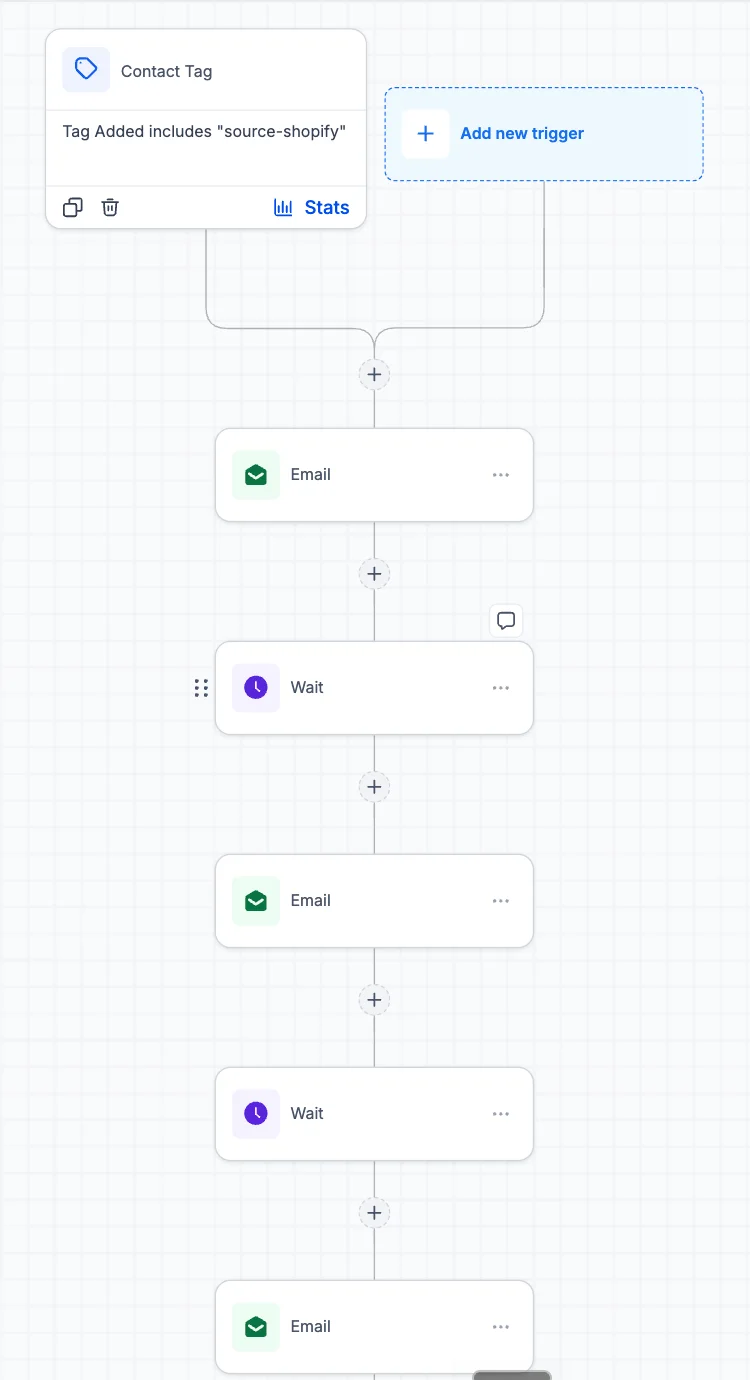
| Pipeline or tags | Cart started, abandoned, first purchase, repeat customer, lapsed or win-back |
| Store integration | Connect Shopify or WooCommerce so order and checkout data reaches the contact record (native Shopify integration, Zapier or webhooks) |
| Source tracking | Tag every contact by acquisition channel so you see which channels produce repeat customers, not only first orders |
| Custom fields | Last order date, order count, average order value, product category |
| Consent fields | SMS and email opt-in status with a timestamp, recorded before any automated marketing message goes out |
| Inbox | Support sees the customer's texts, calls and email next to the order history |
| Reporting | Cart-recovery rate, repeat-purchase rate and win-back conversion by stage |
What the integration can pass depends on the connection you use. Confirm which events (abandoned checkout, order created, fulfilled) reach GoHighLevel before you design workflows around them. Deep product-view tracking is not something to assume.
Where e-commerce revenue leaks
| Leak | Why it happens | What GoHighLevel does |
|---|---|---|
| Abandoned checkouts | Most shoppers who start do not finish, and a single email is easy to miss | A timed multi-touch recovery over email and text |
| One-time buyers | Nothing prompts a second order | Post-purchase welcome and a replenishment reminder timed to the product |
| Lapsed customers | Past buyers go cold with no structured outreach | A win-back sequence triggered by inactivity |
The Baymard Institute, which aggregates dozens of studies, puts the average online cart-abandonment rate at about 70% (70.22% across 50 studies, list updated September 22, 2025). That is the pool recovery draws from, not the share you will recover. Repeat-purchase rates vary widely by category, from low for luxury goods to high for consumables and subscriptions, so compare yourself to your own category and your own history. Recovery rates quoted by software vendors vary too; measure yours.
Core e-commerce workflows: eight to build
| # | Workflow | Trigger | Sequence | Exit |
|---|---|---|---|---|
| 1 | Abandoned-checkout recovery | Checkout started, not completed | Reminder within the hour with the product, a follow-up at about a day, a final touch at two or three days, optionally with an incentive | Purchase |
| 2 | Order confirmation and shipping updates | Order placed, shipped, delivered | Confirmation, tracking link, delivery note | Delivered |
| 3 | Post-purchase welcome | First order completed | Thanks with usage tips, cross-sell of complementary products, reinforce marketing opt-in where you have consent | Sequence ends |
| 4 | Delivery-timed review request | Order marked delivered | Request a set number of days after delivery; low-satisfaction replies go to support instead of a public ask | Review link clicked |
| 5 | Replenishment and repeat-purchase nurture | Approaching the typical reorder window | "Running low?" reminder, reorder or subscribe offer | Reorder |
| 6 | Lapsed-customer win-back | No purchase in your window | Two to three weeks of email and text with an incentive that escalates if you choose | Purchase |
| 7 | Missed-call and chat text-back | Inbound call or chat unanswered | A text within seconds; logged as support or a pre-sale question | Contact replies |
| 8 | Wholesale or consultation intake | Form submitted | Qualification questions, booking link, owner assigned | Booked |
Every text workflow should fire only for contacts with a recorded SMS opt-in, not simply because checkout captured a phone number.
CAN-SPAM and TCPA: consent for automated marketing
E-commerce automation is governed less by health-privacy law and more by consent rules for email and texting.
- Email (CAN-SPAM). The FTC's rule does not require prior consent for commercial email, but each message needs a working unsubscribe link, your valid physical postal address and a non-deceptive subject line, and opt-outs must be honoured within 10 business days. See the FTC compliance guide.
- Texts (TCPA). Automated marketing texts generally require prior express written consent under the FCC's rules. The consent language should say what messages and how often, that consent is not a condition of purchase, and how to opt out.
In practice: record a timestamped opt-in for every contact before any marketing text workflow can include them. US texting also needs A2P registration; see A2P registration. This is an overview, not legal advice; have an attorney check your consent flow before texting at volume.
What GoHighLevel does and does not replace
| System | Replaced by GoHighLevel? |
|---|---|
| CRM and customer contact management | Yes |
| Abandoned-checkout and win-back automation | Yes |
| Funnels and launch landing pages | Yes |
| Review requests and missed-call recovery | Yes |
| Storefront, checkout and payment processing | No |
| Deep product-catalog segmentation and flow branching (Klaviyo) | Partly: segment by tags and fields, not with Klaviyo's depth of store data |
| SMS compliance tooling built for Shopify (Postscript) | Partly |
| Inventory management and fulfilment | No |
GoHighLevel and e-commerce marketing software
Pricing for Klaviyo, Postscript and similar tools scales with profiles or messages and changes often; compare current prices at your list size rather than relying on a table here.
| Function | GoHighLevel | Klaviyo | Shopify Email | Postscript |
|---|---|---|---|---|
| Store data depth | Good through integration | Deepest; built for it | Native | Native (SMS only) |
| Email marketing | Built in | Core strength | Core strength | No |
| SMS marketing | Built in, usage-billed | Built in | No | Core strength |
| CRM, pipeline and calls | Advanced | No | No | No |
| Funnels and landing pages | Built in | No | No | No |
| Pricing model | Flat plan plus usage | Scales with profile count | Free tier, then per-send | Per message or tiers |
Verdict: if the business is a high-volume Shopify operation whose only need is lifecycle email and SMS, Klaviyo, paired with Shopify Email or Postscript, is generally the more purpose-built choice. GoHighLevel is stronger when you also need a CRM, funnels, calls and booking in the same system. Some brands run both, at the cost of more complexity.
What GoHighLevel costs an e-commerce brand
| Item | Cost at the time of writing | Note |
|---|---|---|
| Platform | $97, $297 or $497 a month (HighLevel pricing) | See the pricing guide |
| Texts and email | Usage-based | Scales with list size and send volume |
| Store integration | Setup effort; some connections need Zapier | Included in the build scope |
| Build | Basic setup $500 to $4,000; multi-location by custom quote after a free 30-minute call | See pricing |
To test the case, use your own numbers: monthly checkout starts, your abandonment rate, average order value and the share you could realistically recover. For example, if one in a hundred abandoned carts is recovered, multiply that by your average order value and by your monthly abandoned carts, then compare with the monthly platform and usage cost.
The 60 to 90 day rollout
- Weeks 1 to 2: setup and store integrationAccount, store connection, customer import, pipeline or tags, and consent fields.
- Weeks 3 to 4: recovery and order messagesWorkflows 1 and 2, tested on a subset of traffic.
- Weeks 5 to 8: post-purchase and retentionWorkflows 3 to 5, then launch to the active customer base.
- Weeks 9 to 12: win-back and clean-upWorkflows 6 to 8; review recovery and repeat-purchase data; audit consent records.
When GoHighLevel is and is not a good fit
| Good fit | Poor fit |
|---|---|
| Retail with a wholesale, consultation, pickup or service layer | Pure high-volume Shopify brand needing deep product-catalog segmentation |
| You want CRM, funnels, texting and calls in one system | You need inventory or fulfilment management |
| One generic abandoned-cart email and no SMS today | You are not ready to track SMS and email consent properly |
| A base of lapsed customers with no win-back | No one will own the workflows |
Checkout changed recently: see AI Studio payments and the Contact Created trigger and WhatsApp templates with per-contact media.
Sources and further reading
Checked at the time of writing; prices, features and policies change. Checked 2026-10-19.
- HighLevel pricing page: $97, $297 and $497 plans, unlimited contacts, usage-based charges (read 2026-10-19)
- HighLevel: Shopify integration (what syncs: products, contacts, orders, transactions)
- HighLevel: Abandoned Checkout workflow trigger (works with connected stores such as Shopify; needs the shopper's email address)
- Baymard Institute: cart abandonment rate statistics (70.22%, 50 studies, updated September 22, 2025)
- FTC: CAN-SPAM Act compliance guide for business (opt-out honoured within 10 business days, valid postal address)
- 47 CFR 64.1200 (FCC delivery restrictions): prior express written consent for autodialed marketing calls and texts, prior express consent otherwise, 8 a.m. to 9 p.m. calling hours
- HighLevel: US Phone Number Registrations (A2P 10DLC required for US texts from standard local numbers)
Frequently asked questions about GoHighLevel for e-commerce
Is GoHighLevel good for e-commerce brands?
Yes for brands that want a CRM, checkout recovery, funnels and multi-channel messaging in one system, especially with a wholesale, consultation or service side. It is a weaker primary choice for a pure high-volume Shopify brand that only needs deep product-level email and SMS segmentation.
Is GoHighLevel better than Klaviyo for e-commerce?
Not for pure e-commerce lifecycle email and SMS, where Klaviyo's store-data depth is stronger. GoHighLevel is better when you also need a CRM, funnels, calls and booking in the same system. The right choice depends on where your actual gaps are.
Will GoHighLevel replace Shopify or my storefront?
No, it is the CRM and communication layer beside the store. It does not process payments, manage inventory or replace checkout.
How much does GoHighLevel cost for an e-commerce store?
The platform is $97, $297 or $497 a month at the time of writing, plus usage for texts and email, which scales with list size and volume. Basic setup runs $500 to $4,000, white label $3,500 to $5,000, and multi-location work is a custom quote after a free 30-minute call. See the pricing page.
Can GoHighLevel reduce cart abandonment?
It cannot stop shoppers abandoning, but a timed email and text sequence can recover some of them. The share depends on your traffic, product and offer, and it is worth measuring against your current single-email flow rather than a quoted average.
Do I need consent before sending automated marketing texts?
Yes, automated marketing texts generally need prior express written consent under the TCPA, a higher bar than email under CAN-SPAM. Record a timestamped opt-in and only enrol those contacts in text workflows.
Can I run GoHighLevel and Klaviyo together?
Some brands do, using Klaviyo for store-specific flows and GoHighLevel for CRM, funnels and calls. Two marketing platforms add cost and complexity, so most brands should choose a primary system based on where their gaps are.
Does GoHighLevel integrate with Shopify?
Yes, through a native integration or Zapier and webhook connections that bring order and customer data into the CRM. Which events trigger workflows depends on the connection, so confirm abandoned-checkout and order events before building.
How long does an e-commerce setup take?
A scoped build typically takes a few weeks to get checkout recovery and order messages live, with the full rollout over 60 to 90 days. Store integration and consent tracking are the steps that most often add time.