
GoHighLevel for E-Commerce & Retail Brands: Cart Recovery, Repeat-Purchase Automation & CRM (2026)
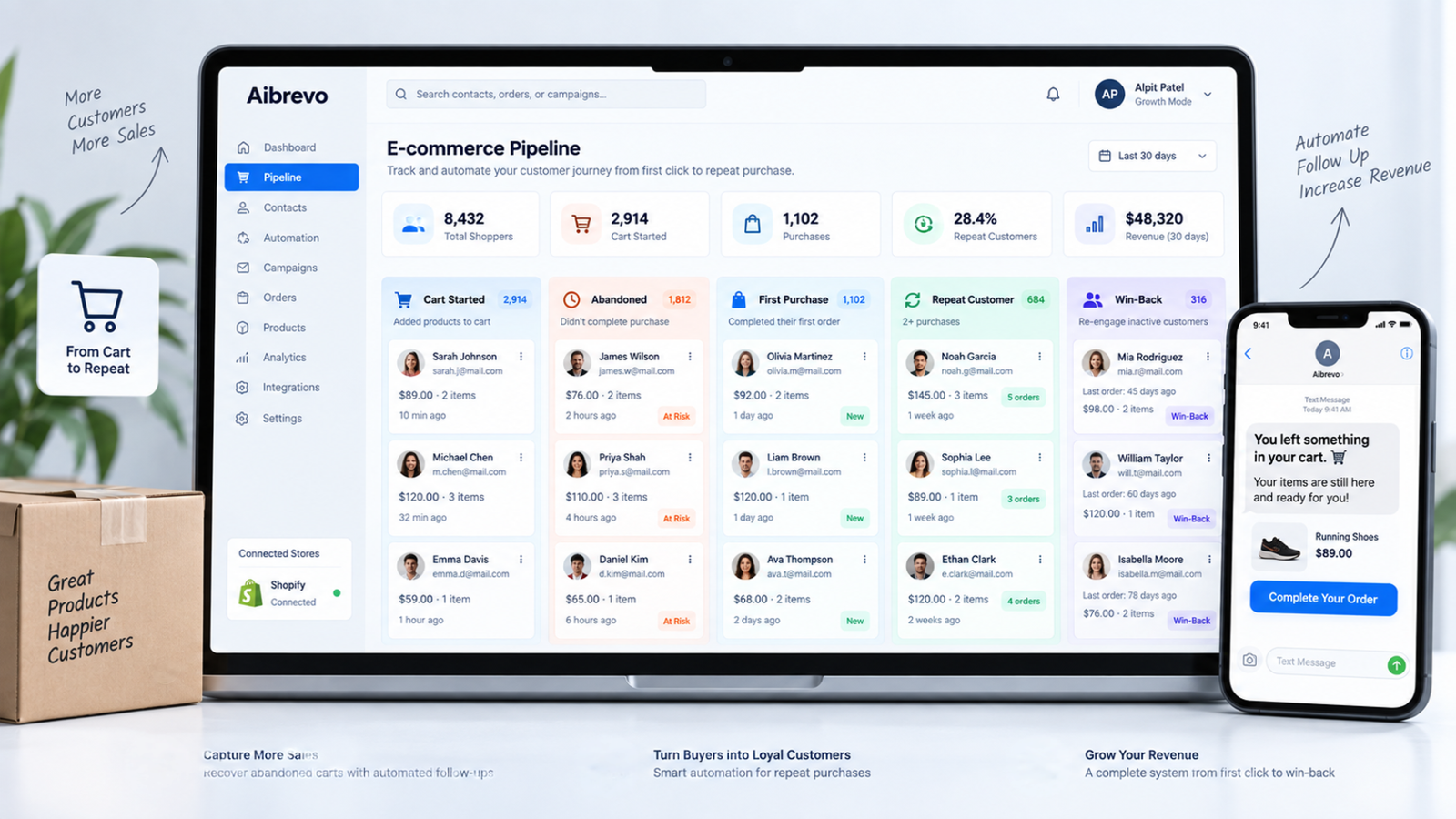
A GoHighLevel pipeline built for an e-commerce brand — customers move automatically from Cart Started through Abandoned Recovery, First Purchase, Repeat Customer, and Win-Back.
Yes, with an important caveat: GoHighLevel automates the CRM, SMS/email communication, and customer-retention layer of an e-commerce or retail brand — cart-abandonment recovery, post-purchase follow-up, repeat-purchase nurture, and win-back campaigns — but for pure email/SMS lifecycle marketing at real product-catalog scale, ecommerce-native tools like Klaviyo are generally the stronger, more purpose-built choice.
Short answer: GoHighLevel works well as a general CRM, funnel, and communication layer for e-commerce and retail brands that also run consultations, wholesale relationships, local pickup, or a service/subscription component alongside their store. For a pure Shopify DTC brand doing high-volume, deeply segmented email/SMS flows, Klaviyo’s ecommerce-specific data depth is usually a better primary tool — see what GoHighLevel does and doesn’t replace below.
Whether GHL produces positive ROI for your store depends on your order volume, current cart-abandonment rate, repeat-purchase rate, and how fragmented your current tool stack already is. This guide covers the cart-abandonment math, the one-time-buyer churn problem, e-commerce CRM setup, the core automation workflows to build, CAN-SPAM/TCPA consent requirements, what it actually costs, and the exact 60-90 day rollout — based on systems we have configured for retail and e-commerce brands across North America. If you’re deciding whether to DIY or hand it to an expert, our done-for-you GoHighLevel setup service covers the implementation at the end.
What’s in This Guide
- Who This Guide Is For
- The E-Commerce Customer Lifecycle & Where GHL Fits
- GoHighLevel E-Commerce CRM Setup
- The Revenue Problem: Cart Abandonment & One-Time-Buyer Churn
- Inside the Dashboard
- Core E-Commerce Workflows (8 Automations Every Brand Needs)
- CAN-SPAM & TCPA: Consent Requirements for Automated Marketing
- What GoHighLevel Does & Doesn’t Replace
- What Automation Actually Changes: Results Data
- GoHighLevel vs. E-Commerce-Specific Software
- Cost, ROI & Break-Even Math
- Implementation Roadmap & 60-90 Day Launch
- FAQ
- When GHL Is & Isn’t a Good Fit
Key Takeaways
- [Published research] Baymard Institute’s meta-analysis across 50+ studies (updated September 2025) puts the average online shopping-cart abandonment rate at approximately 70.2%, with mobile running higher (73-75%) than desktop (65-68%) — nearly identical to the ~70% average the same research has documented for close to two decades.
- [Industry benchmark] Industry data across e-commerce platforms puts the average repeat-purchase rate at roughly 28.2%, ranging from under 10% for luxury goods to 60%+ for subscription and grocery categories — most brands should benchmark against their own category rather than the blended average.
- [Industry benchmark] Multi-step cart-recovery flows that combine email and SMS recover an estimated 18-25% of abandoned carts, versus 10-15% for email-only sequences and a 3-5% industry median for single-touch recovery — the size of that recoverable revenue is the core of the ROI model below.
- [HAT implementation observation] A store recovering an incremental 5% of its abandoned carts through structured multi-touch recovery, on top of an existing single-email flow, can meaningfully change monthly revenue at moderate traffic volumes — the exact dollar impact depends entirely on your average order value and current baseline.
- [Verified pricing, Sept 2026] GoHighLevel’s Unlimited plan ($297/month) includes unlimited contacts, funnels, and workflows for one flat fee, while Klaviyo’s ecommerce-specific pricing scales with subscriber count (roughly $30-45/month at 1,000 profiles, ~$130/month at 10,000) — see the full comparison for what each price buys.
Who This Guide Is For
This guide is designed for:
- DTC and retail brands running Shopify, WooCommerce, or a similar storefront alongside a CRM need beyond pure email marketing
- Brands that also handle wholesale accounts, local pickup/delivery, consultations, or a subscription/service component
- Multi-channel retailers wanting one system for funnels, SMS/email, missed-call recovery, and reviews instead of stitching together 4-5 point tools
- Store owners on Shopify Email or a basic email tool ready for structured, multi-touch automation
If your brand is a pure high-volume Shopify DTC operation whose only real need is deep product-catalog segmentation, read the GHL vs. Klaviyo comparison and the fit section closely — Klaviyo alone may be the better tool. If e-commerce isn’t your industry, see our full GoHighLevel setup guide.
The E-Commerce Customer Lifecycle & Where GHL Fits
An e-commerce brand runs each customer through a repeatable post-purchase lifecycle — the GHL build is a set of automations attached to stages of that lifecycle, not a B2B sales pipeline.
The Five-Stage Lifecycle:
Stage 1: Browse/Cart Started → Abandonment Recovery
- Trigger: Product added to cart or checkout started without completing purchase
- GHL Role: Recover the sale before the customer forgets or buys elsewhere
- Automation: Multi-touch email + SMS recovery sequence with an escalating, time-bound offer
Stage 2: First Purchase → Post-Purchase Onboarding
- Trigger: Order completed
- GHL Role: Confirm the order, set shipping expectations, and start building the relationship past the transaction
- Automation: Order confirmation, shipping/delivery updates, a welcome sequence introducing the brand
Stage 3: Delivered → Review & Feedback
- Trigger: Order marked delivered
- GHL Role: Convert a satisfied first-time buyer into a public review and a second look at the catalog
- Automation: Review request timed to delivery, satisfaction check with an escalation path for complaints
Stage 4: Repeat-Purchase Window → Nurture & Replenishment
- Trigger: Time elapsed since last order approaches the typical reorder/replenishment window for the product category
- GHL Role: Prompt the second and third purchase before the customer defaults to a competitor or forgets to reorder
- Automation: Replenishment reminders, cross-sell/upsell sequences based on purchase history
Stage 5: Lapsed → Win-Back Reactivation
- Trigger: No purchase within the defined inactivity window for the category (commonly 60-120 days for non-subscription retail)
- GHL Role: Win the customer back with a specific incentive before they’re gone permanently
- Automation: Win-back sequence with an escalating, time-bound discount or incentive
The result: Every customer moves predictably through five stages, and the two highest-leverage moments — the abandoned cart and the lapsed repeat-purchase window — trigger an immediate, automatic response instead of relying on the customer to come back on their own.
GoHighLevel E-Commerce CRM Setup
Before building automations, the CRM needs to be structured around how a retail/e-commerce customer relationship actually runs — not GHL’s generic default setup. A proper setup covers:
- Pipeline configuration — Custom stages matching your lifecycle: Cart Started, Abandoned, First Purchase, Repeat Customer, Lapsed/Win-Back
- Store integration — Connecting Shopify/WooCommerce so cart, order, and product data actually populate contact records
- Customer source tracking — Tagging every contact by acquisition channel to see which channels drive repeat customers, not just first orders
- Custom fields — Last order date, lifetime order count, average order value, product category — the data driving which nurture sequence a customer enters
- Consent & compliance fields — SMS/email opt-in status and timestamp tracked per contact before any automated marketing message goes out (see CAN-SPAM/TCPA section)
- Conversation settings — Shared inbox so support staff see a customer’s full text/call/email history alongside order history
- Reporting dashboard — Cart-recovery rate, repeat-purchase rate, and win-back conversion tracked by stage
This setup layer is what most DIY builds skip — they turn on a single abandoned-cart email and stop there, without structuring consent tracking and multi-touch sequencing correctly.
The Revenue Problem: Cart Abandonment & One-Time-Buyer Churn
Leak #1: Cart Abandonment (The Biggest Leak)
The math: Baymard Institute’s meta-analysis of 50+ studies puts the average cart-abandonment rate at roughly 70.2%, and estimates $260 billion in the US and EU alone is recoverable through better checkout design and recovery strategies. A store with 1,000 monthly checkout starts has roughly 700 abandoned carts a month — meaningful revenue left on the table without a structured recovery sequence.
GHL fixes this: Multi-touch email + SMS recovery sequences are associated with materially higher recovery rates (18-25%) than single-touch email-only flows (10-15%) or no recovery flow at all — see the cart-abandonment recovery workflow below.
Leak #2: One-Time-Buyer Churn
The math: Industry benchmark data puts the average e-commerce repeat-purchase rate at roughly 28.2%, meaning the large majority of first-time buyers never return on their own. Because acquiring a new customer typically costs several times more than retaining an existing one, a brand with no repeat-purchase nurture sequence is re-buying the same customer relationship at full acquisition cost every time.
GHL fixes this: A replenishment/nurture sequence timed to the typical reorder window for your product category prompts the second purchase before the customer defaults elsewhere or simply forgets.
Leak #3: Lapsed Customers
The math: A customer who hasn’t purchased in 90-120 days is statistically unlikely to return without a specific reason to — and most brands have no systematic process for identifying and re-engaging this segment, letting a growing list of past buyers go permanently cold.
GHL fixes this: Automated win-back sequences trigger once a customer crosses the inactivity threshold for their category, with a specific, time-bound incentive to return, rather than relying on a generic newsletter to eventually catch them.
Inside the Dashboard
An e-commerce GHL setup isn’t just “a CRM” — it’s three connected systems:
Core E-Commerce Workflows: 8 Automations Every Brand Needs
Workflow 1: Browse Abandonment
Trigger: Customer views a product but doesn’t add it to cart
Sequence:
- Auto-send a follow-up email/SMS referencing the viewed product (opted-in contacts only)
- Auto-include related products or social proof
- Auto-suppress once the customer purchases or adds the item to cart
Catches interest before it fully disappears
Workflow 2: Cart Abandonment Recovery
Trigger: Checkout started, no purchase completed
Sequence:
- Email/SMS within 1 hour: cart reminder with product image
- Follow-up at 24 hours with urgency (limited stock, price hold)
- Final touch at 48-72 hours with a time-bound incentive
Multi-touch email+SMS recovers 18-25% vs. 10-15% for email-only
Workflow 3: Order Confirmation & Shipping Updates
Trigger: Order placed, order shipped, order delivered
Sequence:
- Instant order confirmation
- Shipping notification with tracking link
- Delivery confirmation
Reduces “where is my order” support volume
Workflow 4: Post-Purchase Welcome & Onboarding
Trigger: First order completed
Sequence:
- Thank-you message with brand story/usage tips
- Cross-sell of complementary products
- SMS/email opt-in reinforcement for future offers
Starts building the second-purchase relationship immediately
Workflow 5: Delivery-Timed Review Request
Trigger: Order marked delivered
Sequence:
- Auto-send review request a set number of days after delivery
- Auto-thank customers who leave a review, optionally with a discount for a future order
- Auto-route low-satisfaction responses to support instead of a public review ask
Builds social proof without manual follow-up
Workflow 6: Replenishment / Repeat-Purchase Nurture
Trigger: Time since last order approaches the typical reorder window for the product category
Sequence:
- Auto-send a “running low?” reminder for consumable products
- Auto-offer a subscribe-and-save or reorder-with-discount option
- Auto-suppress once the customer reorders
Directly targets the one-time-buyer churn leak above
Workflow 7: Lapsed Customer Win-Back
Trigger: No purchase within the defined inactivity window (typically 60-120 days)
Sequence:
- Auto-enroll in a win-back sequence with an escalating incentive
- Multi-touch over 2-3 weeks (email, SMS)
- Auto-remove from sequence once the customer reorders
Directly targets the lapsed-customer revenue leak above
Workflow 8: Missed-Call & Chat Text-Back
Trigger: Inbound call or web-chat inquiry goes unanswered
Sequence:
- Auto-text within seconds: “Sorry we missed you — how can we help with your order?”
- Auto-log as a support or pre-sale inquiry
Recovers pre-sale questions that would otherwise go unanswered
CAN-SPAM & TCPA: Consent Requirements for Automated Marketing
Unlike healthcare-adjacent industries where HIPAA governs PHI, e-commerce automation runs into a different — and just as real — compliance requirement: consent for automated SMS and email marketing.
- CAN-SPAM (email): Federal law does not require prior consent to send commercial email, but every marketing email must include a functioning unsubscribe link, your business’s physical mailing address, and an accurate, non-deceptive subject line. Opt-out requests must be honored within 10 business days.
- TCPA (SMS): Automated marketing text messages generally require prior express written consent before you send them — a materially higher bar than email. Consent language should disclose the type and frequency of messages, state that consent isn’t a condition of purchase, and explain how to opt out (e.g., reply STOP). Non-compliant SMS campaigns can trigger statutory damages of $500-$1,500 per violation and real class-action litigation risk — this is not a theoretical concern for high-volume SMS senders.
- Practical implication for GHL builds: Every abandoned-cart, win-back, and nurture SMS workflow in this guide should only fire on contacts with a captured, timestamped SMS opt-in — not simply because they have a phone number on file from checkout.
This is an operational overview, not legal advice. Confirm your specific consent-capture flow and message cadence with an attorney before launching automated SMS marketing at volume.
What GoHighLevel Does & Doesn’t Replace
GoHighLevel handles CRM, multi-channel communication, automation, and funnels — but for a pure e-commerce brand, it doesn’t replace every specialist tool in the stack. Being clear about this upfront avoids the most common source of buyer confusion:
| System | Does GHL Replace It? |
|---|---|
| CRM / customer contact management | Yes |
| Cart-abandonment & win-back automation | Yes |
| Landing pages / funnels for launches | Yes |
| Review requests & missed-call recovery | Yes |
| Storefront / checkout / payment processing (Shopify) | No |
| Deep product-catalog segmentation & flow branching (Klaviyo) | Partial — GHL can segment by tags/fields, but not with Klaviyo’s native Shopify-data depth |
| Native Shopify-only email builder (Shopify Email) | No — different tool, different integration depth |
| SMS-only specialist compliance tooling (Postscript) | Partial — GHL sends SMS but lacks Postscript’s Shopify-specific compliance and segment tooling |
| Inventory management & fulfillment | No |
Be honest about this trade-off: Klaviyo is purpose-built around ecommerce lifecycle revenue, with deep native Shopify data (product views, specific SKUs in cart, purchase history) driving segmentation GHL cannot fully replicate. Shopify Email is free for the first 10,000 sends/month with native store-data integration. Postscript is an SMS-only specialist built around Shopify compliance and subscriber management. GHL’s advantage is breadth — one platform for CRM, funnels, calls, and multi-channel automation — not depth in any single channel.
What Automation Actually Changes: Results Data
[HAT implementation observations] Aggregate patterns we see across e-commerce GoHighLevel implementations — illustrative ranges based on client configurations, not guaranteed results or published research. Every store’s baseline differs:
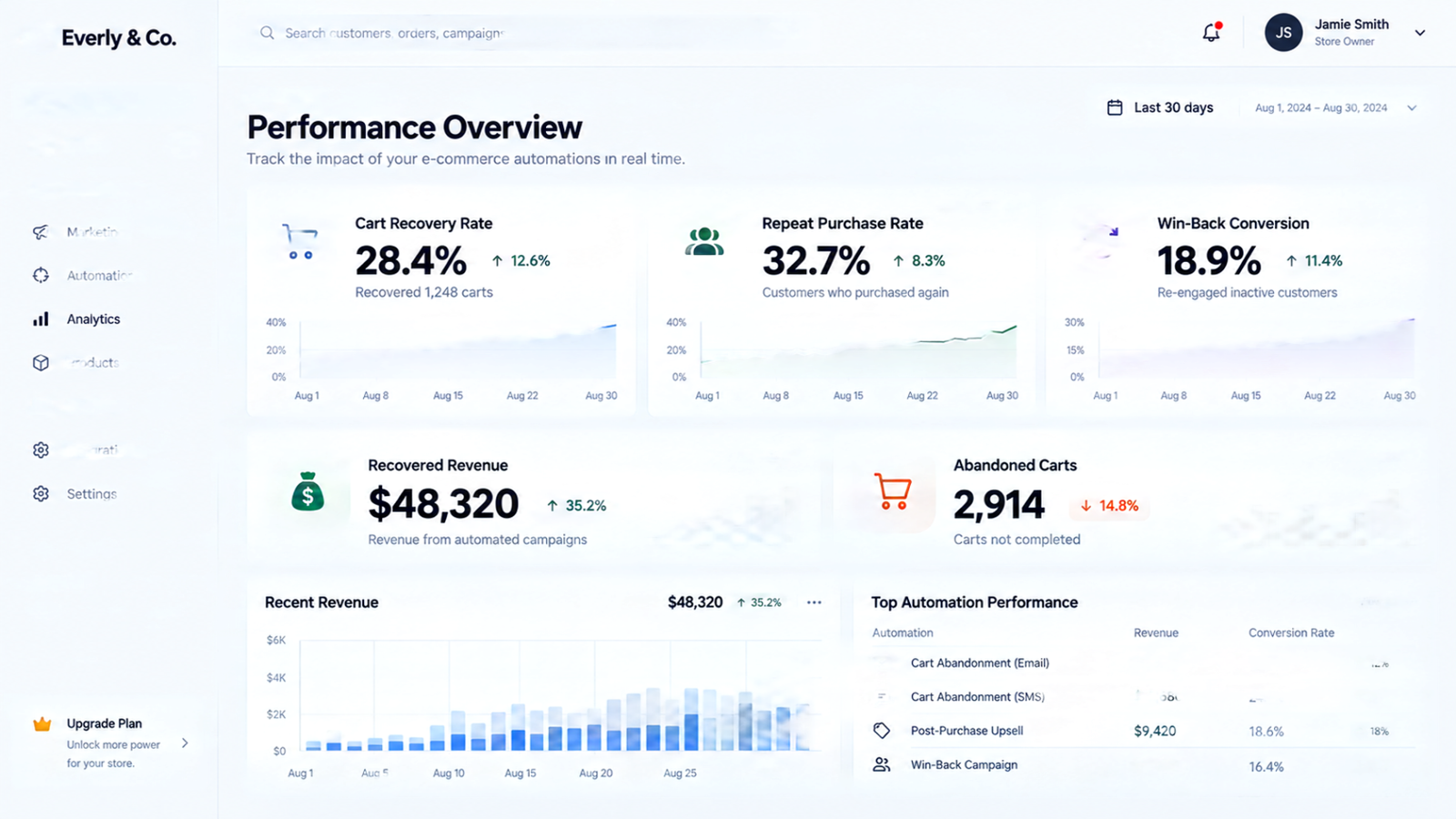
A results dashboard tracking cart-recovery rate, repeat-purchase rate, and win-back conversion after automation is live.

A cart-abandonment recovery workflow: an incomplete checkout triggers a timed email, an SMS follow-up, and a final time-bound offer.
GoHighLevel vs. E-Commerce-Specific Software
Monthly Cost Comparison — Store at ~10,000 Contacts
*Shopify Email is free for the first 10,000 emails/month, then $1 per 1,000 additional emails — cost shown assumes a mid-size monthly send volume. Klaviyo and Postscript pricing scale with subscriber/message volume; figures shown are approximate at the stated contact size. GHL’s price is flat regardless of contact count, but it is not an SMS/email specialist — see the feature table below.
| Feature | GoHighLevel | Klaviyo | Shopify Email | Postscript |
|---|---|---|---|---|
| Native Shopify product/order data depth | Good (via integration) | Deepest — purpose-built | Native | Native (SMS only) |
| Email marketing | Built-in | Core strength | Core strength | Not included |
| SMS marketing | Built-in (usage-based) | Built-in | Not included | Core strength |
| CRM / pipeline / calls | Advanced | Not included | Not included | Not included |
| Landing pages / funnels | Built-in, unlimited | Not included | Not included | Not included |
| Pricing model | Flat monthly fee | Scales with profile count | Free tier, then per-1,000 emails | Pay-per-SMS or flat tiers |
| Best For | Brands wanting CRM, funnels & multi-channel comms in one system | Pure ecommerce lifecycle email/SMS at scale | Simple native Shopify email campaigns | SMS-only specialists wanting deep Shopify compliance tooling |
Verdict: If your business is exclusively a high-volume Shopify DTC operation whose only need is email/SMS lifecycle marketing, Klaviyo (paired with Shopify Email or Postscript) is generally the stronger, more purpose-built choice — its native product-catalog segmentation is deeper than what GHL offers out of the box. GHL earns its place when the brand also needs a CRM, sales funnels, phone/SMS support workflows, or handles customers outside pure self-serve checkout (wholesale, consultations, local pickup). See full GoHighLevel pricing for platform cost details.
Cost, ROI & Break-Even Math
What You’ll Pay
- Platform: $97 (Starter) / $297 (Unlimited) / $497 (Agency Pro) per month — most single-brand stores need Starter or Unlimited depending on contact volume. See full GoHighLevel pricing breakdown
- Store integration: Native or Zapier-based Shopify/WooCommerce connection — typically a one-time setup cost, not ongoing
- Communication (SMS/email): Usage-based, typically $100-400/month depending on send volume and list size
- Implementation: DIY $0 (20-40 hours) or done-for-you $2,000-6,000 (store integration and compliance setup included)
Illustrative ROI Model: Store with 1,000 Monthly Checkout Starts
This is a scenario model built on the stated assumptions — not a forecast or guaranteed result. Your actual numbers depend on your traffic volume, average order value, and current recovery baseline.
Monthly Revenue Impact (1,000 checkout starts/mo, $65 AOV — one scale, dollars only)
Abandoned cart value = ~700 abandoned carts × $65 = ~$45,500. Bars share one scale, so the recovered-revenue and cost bars are shown at their true size relative to the revenue at stake. Assumes a $65 average order value and a 20% blended recovery rate from a multi-touch email+SMS sequence — within the 18-25% range documented for combined-channel recovery flows. A store already running a single-email recovery flow (typically 10-15%) should model only the incremental lift, not the full recovered total.
Cart-abandonment opportunity: 1,000 checkout starts/month at a ~70% abandonment rate = ~700 abandoned carts/month (calculate your own baseline from your storefront analytics)
Recovery model: 700 abandoned carts × 20% recovery × $65 AOV = ~$9,100/month in modeled recovered revenue if assumptions hold
Platform + communication cost: $297 (Unlimited) + ~$150 (SMS/email usage) = ~$450/month = $5,400/year
Even a partial improvement over an existing single-email flow typically clears the platform cost quickly — the size of the return depends entirely on your traffic volume, average order value, and current recovery baseline.
Implementation Roadmap & 60-90 Day Launch
Weeks 1-2: Setup & Store Integration
- Create GHL account, connect Shopify/WooCommerce store data
- Import customer database, configure pipeline stages and consent-tracking fields for SMS/email opt-in
Weeks 3-4: Cart Recovery & Order Communication
- Build Workflows 1-3: browse abandonment, cart-abandonment recovery, order confirmation/shipping updates
- Test with a subset of traffic before full rollout
Weeks 5-8: Post-Purchase & Retention Automation
- Build Workflows 4-6: post-purchase welcome, delivery-timed review request, replenishment/repeat-purchase nurture
- Launch to full active customer base
Weeks 9-12: Win-Back, Missed Calls & Optimization
- Build Workflows 7-8: lapsed customer win-back, missed-call/chat text-back
- Review 60-day cart-recovery and repeat-purchase data; audit consent records against CAN-SPAM/TCPA requirements
FAQ
Q: Is GoHighLevel good for e-commerce brands?
A: Yes, for brands that want a CRM, cart-recovery automation, funnels, and multi-channel communication in one system — especially those with a wholesale, consultation, or service component alongside the store. It’s a weaker primary fit for a pure high-volume Shopify DTC operation whose only need is deep email/SMS lifecycle marketing.
Q: Is GoHighLevel better than Klaviyo for e-commerce?
A: Not for pure ecommerce lifecycle email/SMS — Klaviyo’s native Shopify data depth and product-level segmentation are stronger there. GHL wins when you need CRM, funnels, and phone/SMS support workflows beyond email marketing. See the full comparison above.
Q: Will this replace Shopify or my storefront?
A: No. GHL is the CRM and communication layer that sits alongside your storefront — it doesn’t process payments, manage inventory, or replace checkout. See what it does and doesn’t replace above.
Q: How much does GoHighLevel cost for an e-commerce store?
A: $97-297/month for the platform, plus usage-based SMS/email communication costs, typically $100-400/month depending on volume. See the full cost breakdown above.
Q: Can GoHighLevel reduce cart abandonment?
A: Multi-touch email+SMS recovery sequences are documented to recover 18-25% of abandoned carts versus 10-15% for email-only flows. Actual results depend on your traffic, average order value, and current baseline.
Q: Do I need consent before sending automated marketing texts?
A: Yes — TCPA generally requires prior express written consent before sending automated marketing SMS, a higher bar than email under CAN-SPAM. See the full compliance breakdown above.
Q: Can I run GoHighLevel and Klaviyo together?
A: Some brands do, using Klaviyo for ecommerce-specific flows and GHL for CRM, funnels, and phone/SMS support — but running two full marketing-automation platforms adds cost and complexity, so most brands should pick a primary system based on where their actual gaps are.
Q: Does GoHighLevel integrate with Shopify?
A: Yes, via native integration or Zapier/webhook connections that sync cart, order, and customer data into GHL’s CRM so workflows can trigger off real store events.
When GHL Is & Isn’t a Good Fit
Great Fit If You:
- Run a retail/e-commerce brand that also handles wholesale, consultations, local pickup, or a service/subscription layer beyond pure self-serve checkout
- Want one platform for CRM, funnels, SMS/email, and call/chat support instead of stitching together 4-5 point tools
- Currently rely on a single generic abandoned-cart email with no SMS or multi-touch sequencing
- Have a meaningful base of lapsed repeat customers with no win-back system
Poor Fit If You:
- Run a pure high-volume Shopify DTC brand whose only real need is deep product-catalog segmentation and ecommerce-native email/SMS flows — Klaviyo alone is often the better primary tool
- Need native, real-time inventory and fulfillment management — GHL is not a storefront or ERP
- Aren’t prepared to track SMS/email consent properly before launching automated marketing
Get Started
Your store’s revenue depends on customers completing checkout and coming back for a second order. GHL automates both — so your team isn’t manually chasing every abandoned cart and lapsed customer.
About the Author
Yash Patel — Founder, HighLevel Automation Team
Yash has spent 5+ years building GoHighLevel systems for service and retail businesses, having personally configured automation infrastructure for dozens of clients across North America. His work focuses on CRM architecture, multi-channel communication automation, and customer-retention systems, including cart-recovery and repeat-purchase automation for e-commerce and retail brands. Connect with him on LinkedIn.
Expertise: GoHighLevel CRM · E-Commerce Marketing Automation · Cart-Recovery Systems · Customer Lifecycle Automation · Multi-Channel Compliance (CAN-SPAM/TCPA)
Editorial review: This guide was written by Yash Patel and reviewed against primary sources (GoHighLevel and Klaviyo official pricing documentation, Baymard Institute research, FTC CAN-SPAM guidance, and the trade and industry-benchmark literature linked inline) before publication. Statistics are attributed to their sources and dated to publication time; forward-looking figures are labeled as benchmarks or models rather than guarantees.