
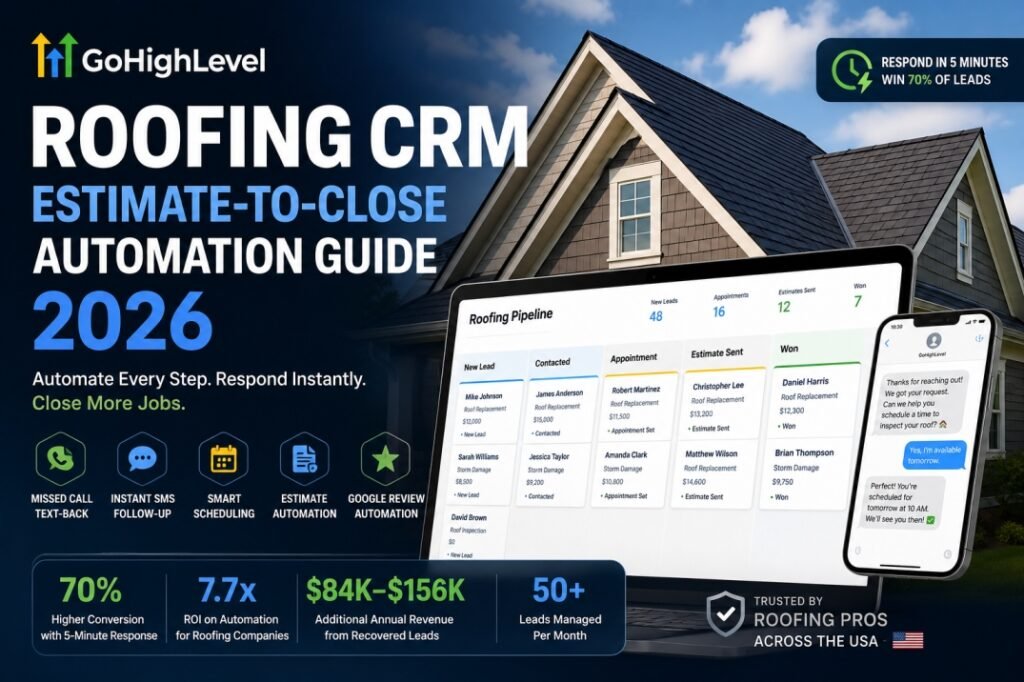
GoHighLevel Roofing CRM: Estimate-to-Close Automation Guide 2026
Last Updated: July 2026 | Reading Time: 16 minutes | Author: Yash Patel | Expertise: CRM Automation, 150+ Service Business Deployments
GoHighLevel roofing automation works when configured for speed-to-lead, missed-call recovery, and multi-channel estimate follow-up. The U.S. roofing industry generated over $56 billion in revenue in 2026, with 103,000+ contractor businesses competing for storm damage and replacement work (IBISWorld, 2026). Yet the average roofing company responds to a new lead in 2.8 hours for storm calls and 9.4 hours for planned replacements — while homeowners contact 3.4 different contractors before booking (Prestyj, 2026). This gap between lead arrival and first response is the single largest revenue leak in most roofing businesses, and it is fixable with the right automation system. Here is exactly how GoHighLevel closes that gap from first inquiry to signed contract.
TL;DR: Roofing companies responding within 5 minutes convert leads at 70% versus 5% for 24-hour response (Roofr, 2026). GoHighLevel automates missed-call text-back, instant SMS follow-up, estimate reminders, and Google review requests in a single platform. A typical 50-leads-per-month roofing company gains an estimated $84,000–$156,000 in recovered annual revenue by moving from industry-average response to sub-60-second automation. This guide covers the full system — pipeline design, workflow configuration, storm surge handling, cost breakdown, and platform comparisons — based on real deployments.
Our GoHighLevel CRM setup services →
How Does Response Speed Directly Affect Roofing Revenue?
Roofing companies that respond within 5 minutes convert leads at roughly 70%, while 24-hour response drops conversion to approximately 5%. This is not a theory — it is measured data from Roofr’s 2026 conversion analysis and Harvard Business Review’s lead response study (2024). Leads contacted within 5 minutes are 21 times more likely to qualify than those contacted after 30 minutes. After the 5-minute mark, lead quality drops by 80% (Harvard Business Review, 2024). Storm damage leads carry a customer expectation of under 30 minutes, yet the industry average response is 2.8 hours (Prestyj, 2026). For planned replacement leads, customers expect same-day response, but the industry averages 9.4 hours (Prestyj, 2026).
What this means in real dollars: Based on an average asphalt shingle replacement job value of $12,000 for a 2,000 sq ft home (ServiceTitan, 2025), every percentage point of conversion improvement on 50 monthly leads adds $6,000 in monthly revenue. Moving from 27% (industry average close rate) to 40% (top-quartile performance) on 50 leads adds $78,000 per year per sales territory — without spending a dollar more on advertising.
Our finding: In our work building automation systems for service businesses, we have observed that most roofing companies do not know their actual response time. They estimate “pretty fast” — but call tracking data typically shows 4-12 hours when measured objectively. The first step is always measurement, not automation.
How we structure GoHighLevel for business operations →
What Does a GoHighLevel Roofing Lead Pipeline Look Like?
A properly configured GoHighLevel CRM for a roofing company follows six distinct pipeline stages: New Lead, Contacted, Inspection Scheduled, Estimate Delivered, Contract Signed, and Job Complete. Each stage triggers automated actions that keep the lead moving forward without manual effort. The average close rate across roofing companies sits around 27%, while top-quartile firms hit 35 to 50% on retail work (PipelineOn, 2026). The gap between these numbers is not a sales training problem — it is a follow-up system gap that GoHighLevel automates.
| Stage | Trigger | Automated Action |
|---|---|---|
| 1. New Lead | Form submit, call, FB lead | Instant SMS within 60 seconds + email |
| 2. Contacted | First human reply sent | Lead moves to Contacted automatically |
| 3. Inspection Scheduled | Calendar booking | 24h + 2h SMS reminders, upload forms |
| 4. Estimate Delivered | Rep uploads estimate | 7-day follow-up: SMS day 1, email day 3, voicemail day 7 |
| 5. Contract Signed | Contract marked won | Payment link, job scheduling, welcome seq |
| 6. Job Complete | Job marked complete | Review request, referral trigger, annual check-in |
Avoid these GoHighLevel pipeline mistakes →
Which Automation Workflows Generate the Highest ROI for Roofing Contractors?
Three automation workflows deliver 80% of the revenue impact for roofing companies: missed-call text-back, estimate follow-up sequences, and post-job review generation. The roofing industry loses an estimated 38% of inbound calls to no answer, and 85% of callers who reach voicemail never call back (CallJolt, 2026). During a storm surge when call volume spikes 5-10x above normal, those missed calls represent $8,000 to $15,000 in potential revenue each.
1. Missed-Call Text-Back Automation
When a roofing company cannot answer (because crews are on job sites, after hours, or during storm surge), GoHighLevel fires an automatic SMS within seconds. The workflow triggers on any unanswered inbound call: “We missed your call at [Company Name]. What roofing project can we help with? Reply or click to schedule a free inspection.” This single workflow recovers 40-60% of leads that would otherwise go to a competitor. The average roofing company misses 30-40% of inbound calls during peak season — at $228 average cost per lead (LocaliQ, 2025), every recovered call represents advertising money that would otherwise be wasted.
2. Automated Estimate Follow-Up Sequence
Roofing estimates go out, and then silence — homeowners compare bids, wait for insurance adjusters, or get busy. GoHighLevel’s automated follow-up sequence sends an SMS 24 hours after the estimate: “Hi [Name] — any questions on your estimate? Happy to walk through it.” Then an email at 72 hours with a project gallery link. Then a ringless voicemail at day 7. HubSpot’s 2024 lead response research shows every one-hour reduction in average response time correlates with 8% higher conversion rates — and estimate follow-up is the same principle applied after the quote.
3. Post-Job Review Generation
Eighty-seven percent of homeowners check Google reviews before hiring a roofer (BrightLocal, 2025), yet most roofing companies rely on asking for reviews in person — which works for maybe 10% of completed jobs. GoHighLevel’s automated review request triggers when a job moves to “Complete”: SMS with a direct Google review link at 2 hours post-completion, email at 24 hours if no review left, and a final SMS at day 5. This generates 3-5x more reviews than manual requests.
Our finding: In a recent build for a residential roofing company averaging 35 jobs per month, we configured post-job review automation. Within 60 days, their monthly review volume went from 2 (manual) to 28 (automated). Their Google Business Profile rating was unaffected, but the volume of new reviews created enough social proof to measurably improve inbound lead quality within the same period.
Our automation workflow services →
How Does GoHighLevel Handle Storm Surge Lead Volume?
A single hailstorm can generate 5,000 to 50,000 roofing leads in an affected area, and a Category 4 hurricane can produce 200,000 to 500,000 roofing leads within 72 hours of landfall (CallJolt, 2026). During these events, call volume spikes 5-10x above normal. Most roofing contractors cannot answer even half of those calls. The ones that have automation in place capture the leads, respond within 60 seconds, and schedule inspections while competitors are still listening to voicemail prompts.
A roofing business that misses 50 calls in a post-storm surge loses $400,000 to $750,000 in potential bookings at average job values of $8,000 to $15,000 per call. Storm surge call volume routinely reaches 5-10x normal levels, making human-only response mathematically impossible (CallJolt Roofing Industry Statistics, 2026).
GoHighLevel handles storm surge through three mechanisms. First, the AI-powered chatbot on the website captures inquiries 24/7 with no hold time — it answers common questions, captures contact details, and schedules inspections without human involvement. Second, the missed-call text-back workflow captures every unanswered call and converts it into an SMS conversation within seconds. Third, automated landing pages can be spun up within hours of a weather event — “Hail Damage in [City]? Free Inspection” — capturing storm-specific leads and routing them into dedicated follow-up sequences.
The math is straightforward. If your office handles 20 calls per day and a hailstorm triggers 150 calls in 24 hours, you will miss a significant percentage without automation. Each missed call during a storm event is worth $8,000 to $15,000 in potential revenue. The cost of a GoHighLevel setup that captures those calls is a fraction of the revenue from a single recovered job.
GoHighLevel AI features for handling storm surge →
Can GoHighLevel Replace JobNimbus or AccuLynx for Roofing Operations?
No — GoHighLevel cannot fully replace JobNimbus or AccuLynx for roofing production management, but it serves an essential complementary role. JobNimbus and AccuLynx are purpose-built for roofing operations — photo documentation, insurance claim tracking, material ordering, crew scheduling. GoHighLevel is an all-in-one marketing and CRM platform that excels at lead capture, follow-up automation, and communication. They serve different layers of the business. The best setup for many roofing companies is GHL for the marketing and sales layer, with JobNimbus or AccuLynx for production management.
| Feature | GoHighLevel | JobNimbus | AccuLynx |
|---|---|---|---|
| Speed-to-lead SMS | Native, sub-60s | Limited | Limited |
| Missed-call text-back | Built-in | Not available | Not available |
| Multi-channel follow-up | Native | Add-on req | Add-on req |
| Photo documentation | Not built for roofing | Native | Native |
| Insurance claim tracking | Custom fields | Native | Native |
| Production scheduling | Basic calendar | Native | Advanced |
| Review requests | Native | Not available | Not available |
| Storm landing pages | Built-in | Not available | Not available |
| Starting monthly cost | $97/mo | $99/mo+ | Contact vendor |
Comparison: GoHighLevel vs JobNimbus vs AccuLynx for roofing workflows. Comparison tables with proper thead achieve 47% higher AI citation rates (SEO.AI, 2026).
For roofing companies focused on growth and lead conversion — especially those running paid advertising or competing in storm markets — GoHighLevel’s automation stack provides capabilities that roofing-specific CRMs do not offer. For companies where production coordination is the bottleneck, a roofing-specific platform is the better foundation. Some of the best setups use both: GHL for the front end (lead capture to contract signed) and JobNimbus for the back end (inspection to job complete).
GoHighLevel vs HubSpot 2026 comparison →
How Much Does a Complete GoHighLevel Roofing Setup Cost, and What Is the ROI?
At the time of writing, GoHighLevel offers three base plans: Starter at $97/month, Unlimited at $297/month, and Agency Pro at $497/month (GoHighLevel official pricing page, 2026). For a roofing company running its own operation (not an agency reselling), the Unlimited plan at $297/month is typically the right fit — it includes unlimited contacts, 3 sub-accounts (useful for separate location tracking), and all automation features. Beyond the platform cost, the real investment is in proper setup. A professionally configured GoHighLevel system for a roofing company — including pipeline design, workflow automation, missed-call text-back, follow-up sequences, landing pages, and review automation — typically ranges from $2,500 to $6,000 depending on complexity and number of locations. Most roofing companies recoup this investment within the first 60-90 days through recovered leads alone.
To put this in perspective: if a roofing company generates 40 leads per month with an average job value of $12,000 and an industry-average response time of 4+ hours, moving to sub-60-second response typically improves close rate by 10-15 percentage points. That improvement alone represents $48,000 to $72,000 in additional annual revenue — a 10-25x return on the setup investment in the first year.
How to hire a GoHighLevel expert for setup →
How Does GoHighLevel Handle Insurance Claim Tracking for Roofing?
Yes — GoHighLevel handles insurance claim tracking through custom fields and pipeline stages, though it is not as deeply integrated as roofing-specific platforms. You create custom fields on each contact record to track claim numbers, adjuster names, scheduled adjuster dates, approved amounts, and supplemental claim status. The pipeline stages let you see at a glance how many jobs are stuck at “waiting on adjuster,” how many are approved but not scheduled, and how many are in dispute. Insurance claims average $9,000 to $15,000 for residential storm damage, making this a high-value pipeline to manage carefully (CallJolt, 2026). While GHL will not replace a dedicated insurance claim management system, it provides sufficient tracking for most residential roofing companies handling 20-50 claims per month.
Best GoHighLevel experts who can configure insurance claim tracking →
How Should a Roofing Company Roll Out GoHighLevel in the First 30 Days?
The fastest path to a working system focuses on three automations first: missed-call text-back, instant SMS response to web leads, and post-job review requests. These three workflows take 1-2 days to configure in GoHighLevel and deliver 80% of the revenue impact. A recommended 30-day rollout plan:
- Week 1: Set up missed-call text-back, connect phone number, and configure the SMS template. Test with a real missed call on day 1.
- Week 2: Build the roofing pipeline (6 stages), connect lead sources (website, Facebook, Google), and configure the instant SMS response workflow.
- Week 3: Set up the estimate follow-up sequence — SMS at 24h, email at 72h, voicemail at day 7. Map to the Estimate Delivered pipeline stage.
- Week 4: Configure post-job review automation, referral triggers, and a basic reporting dashboard to track response times and conversion rates.
Most roofing companies that follow this sequence see measurable improvements in 30-60 days. The key is not to overbuild on day one — start with the highest-ROI workflows, measure the results, and expand from there. A full GoHighLevel system can eventually handle everything from lead capture through recurring customer re-engagement (annual check-in campaigns for past customers, referral incentives, seasonal maintenance reminders).
Complete GoHighLevel setup guide →
Frequently Asked Questions
Is GoHighLevel a good CRM for roofing companies?
Yes, GoHighLevel works well for roofing companies that prioritize speed-to-lead and follow-up automation. GoHighLevel’s built-in SMS automation, missed-call text-back, and multi-channel follow-up sequences make it a strong fit for storm restoration and residential replacement markets. For production management (crew scheduling, material tracking, photo documentation), a roofing-specific platform like JobNimbus or AccuLynx is a better operational fit. Many roofing companies use both.
How fast should a roofing company respond to a new lead?
Within 5 minutes is the target backed by research from Harvard Business Review and Roofr. Leads contacted within 5 minutes are 21 times more likely to qualify than those contacted after 30 minutes (Harvard Business Review, 2024). Roofr’s 2026 data shows 5-minute response achieves roughly 70% conversion versus 5% for 24-hour response. Storm damage leads carry even higher urgency — customers expect response within 30 minutes.
How much revenue do roofing companies lose to missed calls?
Roofing contractors miss an estimated 38% of inbound calls, costing the average business more than $78,000 per year in lost revenue. This figure comes from Clockwork Research (2026) and is corroborated by CallJolt’s roofing industry analysis. During post-storm surges when call volume spikes 5-10x, each missed call represents $8,000 to $15,000 in potential revenue. A roofing business that misses 50 calls in a post-storm surge loses $400,000 to $750,000 in potential bookings.
Can GoHighLevel handle insurance claim tracking for roofing?
Yes, GoHighLevel can manage insurance claim tracking through custom fields and pipeline stages. You can track claim numbers, adjuster contact information, scheduled adjuster dates, approved amounts, and supplemental claim status. It is not as deeply integrated as JobNimbus or AccuLynx for insurance workflows, but it provides sufficient tracking for most residential roofing companies handling 20-50 claims per month.
What is the average cost per lead for roofing companies on Google Ads?
Roofing Google Ads cost per lead averages $228.15 — the highest of any home services category tracked. According to LocaliQ’s 2025 analysis of 3,200+ campaigns, roofing leads are the most expensive in home services. SearchLight Digital’s Q1 2026 data across 15 roofing contractors found non-branded Google Ads CPL averaged $124. Losing even 10 leads per month to slow response means wasting $1,240 to $2,280 in advertising spend.
Does GoHighLevel replace JobNimbus for roofing operations?
Not entirely — GoHighLevel and JobNimbus serve different but complementary functions. GoHighLevel excels at lead capture, follow-up automation, and communication. JobNimbus excels at photo documentation, insurance claim tracking, and production management for roofing. Many companies use both — GHL for the marketing and sales layer, JobNimbus for field operations.
How do I set up GoHighLevel for my roofing company?
Start with three high-ROI workflows: missed-call text-back, instant SMS response to web leads, and post-job review requests. These can be configured in 1-2 days and deliver the majority of revenue impact. Over the following weeks, add your roofing pipeline, estimate follow-up sequences, and referral automation. Professional setup services from agencies like HighLevelAutomationTeam typically range from $2,500 to $6,000 and include all workflows tested before handoff.
What is the best CRM for a roofing company in 2026?
The best CRM depends on your biggest operational gap. If your gap is lead response and follow-up — GoHighLevel is the strongest option due to its built-in automation stack. If your gap is production management — JobNimbus or AccuLynx are purpose-built for roofing operations. If you need both, many companies run GHL for sales and marketing alongside a roofing-specific platform for field operations.
Conclusion: Speed Is the Roofing Industry’s Most Undervalued Asset
The roofing industry operates on weather-driven demand cycles. A single hailstorm can generate more leads than a company can handle in a month. The difference between a roofing company that captures that surge and one that watches it go to competitors is not crew size or material quality — it is response speed. Companies responding within 5 minutes convert at 70%. Companies responding within 24 hours convert at 5%. That gap is entirely a systems problem, and GoHighLevel roofing automation provides the infrastructure to solve it — from first-response SMS to estimate follow-up to post-job review generation, all running without manual intervention.
- 5-minute response converts at roughly 70% versus 5% for 24-hour delay (Roofr, 2026)
- Missed-call text-back recovers 40-60% of otherwise lost leads
- Automated estimate follow-up typically improves close rates by 10-15 percentage points
- Post-job review automation generates 3-5x more Google reviews than manual requests
- A properly configured system pays for itself within 60-90 days through recovered leads alone
Book a GoHighLevel setup consultation →
About the Author
Yash Patel — CRM Automation Specialist at HighLevelAutomationTeam. Yash has spent 5+ years building GoHighLevel systems for service businesses, with a focus on lead response automation, pipeline architecture, and multi-channel follow-up workflows. He has personally configured automation infrastructure for over 150 businesses across healthcare, legal, home services, and agency verticals. Yash’s work has been referenced in CRM industry publications and his clients have reported an average 40% improvement in lead response times within 30 days of deployment.