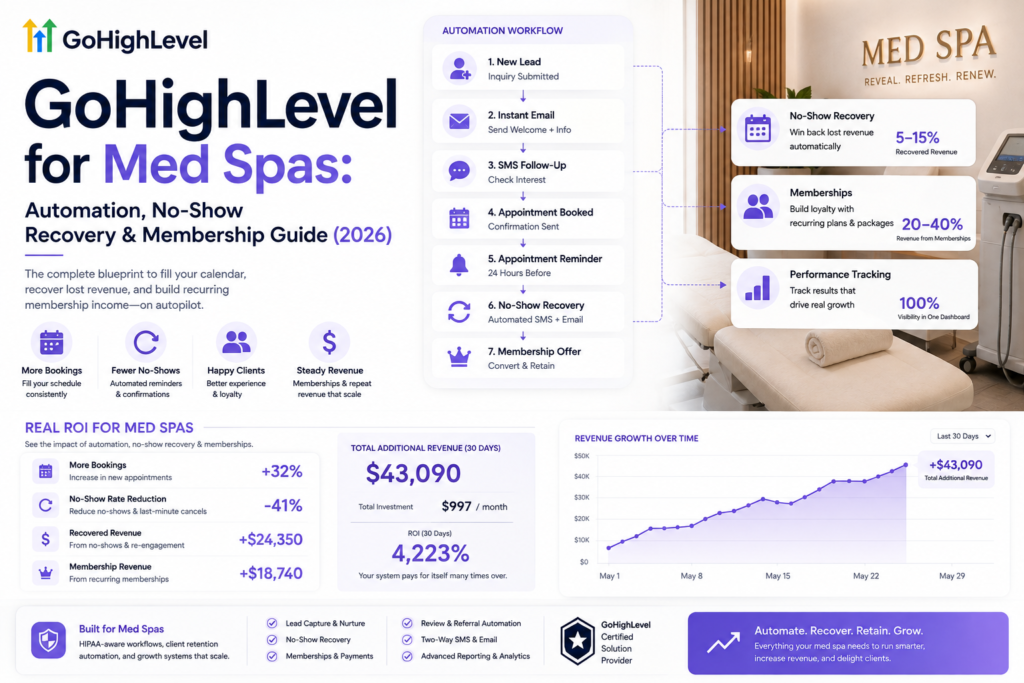
GoHighLevel for Med Spas: CRM, Automation & Retention Guide (2026)
By Yash Patel — Founder, HighLevel Automation Team
Yes — GoHighLevel can be a strong automation and communication layer for med spas, especially for lead response, appointment follow-up, no-show recovery, reactivation, memberships, and lead nurturing. It should generally complement — not replace — the practice-management or clinical system that owns treatment and clinical records.
Best for: Lead capture, speed-to-lead, booking, reminders, missed calls, reactivation, memberships, and marketing automation.
Not designed to replace: Clinical documentation, treatment records, medical charting, payroll, or EVV-style operational systems.
Terminology used in this guide: Lead = prospective patient before booking. Patient/client = someone who has completed a consultation or treatment. Member = recurring membership customer. Dormant patient = no completed visit within your defined inactivity period (typically 90+ days).
Last updated: September 2026. Research reviewed: Grand View Research market reports, American Med Spa Association industry data, peer-reviewed studies indexed in PubMed, GoHighLevel official documentation, and HHS guidance at the time of writing. All pricing, plan eligibility, and BAA statements are “at the time of writing” and subject to change. This is an operational guide, not legal or medical advice — confirm compliance obligations with a healthcare attorney before routing PHI through any platform.
Who This Guide Is For
This guide is designed for med spa owners, medical directors, practice managers, aesthetic clinic operators, med spa marketing managers, and agencies implementing GoHighLevel for med spas. It is especially relevant for practices using Zenoti, Nextech, or another practice-management platform that needs a dedicated lead-response and retention layer.
This guide is the retention-focused playbook most med spa “GHL for med spas” articles skip. It covers the no-show math, the membership drop-off problem, the reactivation economics, the exact med spa automation workflows to build, how to stay HIPAA-eligible, what it actually costs, and the pipeline a medical spa should run — based on systems we have configured for healthcare clinics and med spas across North America. If you’re deciding whether to DIY or hand it to an expert, our done-for-you GoHighLevel setup service covers the difference at the end.
What’s in This Guide
- How GHL fits a med spa (patient lifecycle)
- The revenue leaks GHL can address: no-shows, membership drop-off, dormant patients
- The 9 core med spa workflows
- Membership automation: retention and benefit tracking
- No-show & empty-chair recovery
- AI voice for med spa clinics
- GoHighLevel vs. med spa software (Zenoti, Nextech)
- HIPAA, TCPA & communication compliance
- GoHighLevel cost & ROI
- Implementation & 90-day roadmap
- The KPI dashboard
- When GHL is / isn’t a good fit
- FAQ
Key Takeaways
- The US med spa industry is estimated at approximately $9.3 billion in 2026 and is projected to reach $33.2 billion by 2035 at a 15.2% CAGR (Grand View Research, 2026). There are now over 11,000 med spas operating across the United States (American Med Spa Association, 2024).
- Med spa appointment no-show rates vary widely — industry analyses report rates from 4–5% with advanced reminder systems to 17–22% without systematic follow-up. At $164–$500 per treatment visit, a single-location med spa doing 245 monthly visits loses an estimated $1,500–$17,000 per month from no-shows and cancellations (planning model; practices should calculate their own baseline).
- Patient rebooking is the single biggest retention inflection point: 37% of first-visit patients cancel and never rebook, but cancellation rates drop dramatically after the second visit. Getting a patient to return even once dramatically increases lifetime value.
- A well-run membership program retains 65–75% of members, generates significant recurring revenue, and delivers a lifetime value roughly 2.7× higher than non-members (SchedulingKit, 2025; Zenoti, 2026).
- GHL is HIPAA-eligible, not HIPAA-certified — you need the $297/month HIPAA add-on plus a signed BAA before PHI flows through it. Not every message a med spa sends is automatically a HIPAA communication, and not every marketing message is automatically outside HIPAA. The classification depends on what information is being used, why it is being used, and how it was obtained. Map each data flow before PHI is placed into GHL, and obtain qualified legal/compliance advice for the practice’s specific situation.
Quick Answers
Five direct answers to the questions this article is really being asked — written so the first sentence is extractable for featured snippets and AI answer engines:
Is GoHighLevel good for med spas? Yes. It is best used as the communication, membership, and retention layer alongside your med spa practice management software — not as a replacement for it.
Can GoHighLevel automate med spa memberships? Yes. GHL can manage membership sign-ups, renewal reminders, payment collection, and tier upgrade sequences as automated workflows.
Does GoHighLevel replace Zenoti or Nextech? No. Keep clinical records, treatment protocols, and billing in your med spa software; GHL runs the patient-facing communication, membership, and marketing layer beside it.
Can GoHighLevel recover med spa no-shows? Yes. Appointment-status triggers launch separate no-show recovery and rescheduling workflows, distinct from cancellation handling.
Can GoHighLevel automate treatment follow-up and rebooking? Yes. Post-treatment sequences can trigger next-appointment booking prompts, aftercare check-ins, and treatment-plan adherence follow-up based on visit data.
The Med Spa Retention Lifecycle: Where Each GoHighLevel Automation Fits
Before any workflow, understand the shape of the system. A med spa runs one patient through the same lifecycle again and again — and the entire GHL build is a set of automations attached to stages of that lifecycle. Here is the master map: every trigger in the spa connects to a stage, and every stage has an automation job.
Terminology used in this guide: Lead = prospective customer. Patient/client = someone who has completed a consultation or treatment. Member = recurring membership customer. Dormant patient = no completed visit within your defined inactivity period (typically 90+ days).
The point of drawing it this way is that every workflow in the rest of this guide maps to a stage above — there is no workflow that exists outside this map. When a build goes wrong, it is almost always because a workflow was attached to the wrong stage or duplicated across two stages. This section is the reference: come back to it when a sequence feels redundant.
The med spa lifecycle is slightly longer than a standard dental or chiropractic lifecycle because of the treatment-series structure: a patient books a consultation, receives a first treatment, commits to a package or series (3–6 sessions), then transitions into a membership or maintenance cadence. The membership stage is where the recurring revenue lives — and it is also where the biggest automation opportunity sits.
What Should Be the Source of Truth?
| Clinical / practice-management system (Zenoti, Nextech) | GoHighLevel |
|---|---|
| Clinical records, treatment documentation, consents | Lead capture, inquiry response |
| Treatment history, medical history | Communication, nurture sequences |
| Billing, payments, membership billing | Pipeline management, follow-up |
| Inventory, provider records | Marketing automation, reactivation |
| Primary scheduling calendar | Review requests, reputation management |
This is the single most important architectural decision in a med spa GHL build: the clinical system is the source of truth for patient data; GHL is the source of truth for patient communication. Never try to make GHL the clinical record. It will fail, and it will create compliance risk.
Master Med Spa Automation Architecture
Each automation flow below is a standalone system with its own triggers, conditions, actions, wait steps, branch logic, and exit rules. These are the production-ready architectures — not conceptual outlines. Every node maps to a GHL workflow step.
Flow 1: New Lead → Inquiry Response
Flow 2: No-Show / Cancellation Recovery
Flow 3: Treatment Follow-Up & Series Adherence
Flow 4: Membership Renewal & Benefit Tracking
Flow 5: Dormant Patient Reactivation
Each flow above is a standalone GHL automation with its own trigger, conditions, actions, waits, branches, and exit rules. When building, start with Flow 1 (New Lead) — it produces the fastest ROI. Then Flow 2 (No-Show), then Flow 3 (Treatment Follow-Up), then Flow 4 (Membership), then Flow 5 (Reactivation).
Why Med Spas Need Automation More Than Most Aesthetic Practices
Med spas are not single-transaction businesses. A patient who books Botox today should rebook in 3–4 months. A patient who starts a laser series should complete 6–8 sessions over 12–18 weeks. A CoolSculpting patient should return for follow-up and additional cycles. That structure means the practice depends on rebooking and adherence, not just acquisition — and adherence is exactly what manual follow-up fails at. If you are evaluating GHL for other practice types, our GoHighLevel for chiropractors guide and GoHighLevel for optometrists guide cover those specialties in similar depth.
Med spa software such as Zenoti and Nextech already covers substantial parts of scheduling, memberships, client communication, retention, and operational management. The reason to add GoHighLevel is not because those platforms cannot communicate with patients — it is because a practice may want a separate, highly customizable automation and marketing layer for lead capture, speed-to-lead, multi-step nurture, missed-call recovery, reactivation, campaign orchestration, reporting, or agency-managed workflows. For a deeper look at GHL’s automation capabilities, see our GoHighLevel setup guide.
The right architecture depends on the practice’s existing technology stack. GHL should complement the system that owns clinical and operational records rather than being positioned as a universal replacement for purpose-built med spa software.
Terminology: Revenue Recovered vs. Generated vs. Retained
| Revenue type | Definition | Example |
|---|---|---|
| Revenue recovered | Previously lost appointments that were rescheduled | No-show patient rebooks after automated recovery text |
| Revenue generated | New appointments from leads or reactivation | Dormant patient books after win-back campaign |
| Revenue retained | Membership revenue that might have been lost through churn | Member stays after pre-billing reminder and benefit nudge |
| Revenue Leak | What’s happening | Revenue at risk (planning model) |
|---|---|---|
| No-shows & last-minute cancellations | Empty treatment rooms with no revenue per hour | $1,500–$17,000/month per location (planning model) |
| First-visit non-rebooking | 37% of first-visit patients never return | Derived from industry benchmarks (planning model) |
| Treatment-series drop-off | Patients stop midway through a 6-session laser series | Derived from typical package pricing (planning model) |
| Membership lapses | Members cancel without a re-engagement touch | Derived from typical membership pricing (planning model) |
| Dormant patient list | Patients who visited once and never returned | Derived from typical reactivation rates (planning model) |
The pattern is the same as any recurring-service business: the money is not in the first visit, it is in the second, third, and tenth. Automation is the system that gets patients to the second visit — because after that, the treatment experience does most of the work.
The No-Show Problem: The Math That Justifies GHL Alone
No-shows are among the most expensive silent leaks in a med spa, because the treatment room is only billable when a body is in it. Industry analyses report no-show rates ranging from 4–5% with advanced reminder and card-on-file systems to 17–22% without systematic follow-up. At treatment fees of $164–$500, a single-location med spa doing 245 monthly visits loses an estimated $1,500–$17,000 per month from no-shows and cancellations (planning model; practices should calculate their own baseline).
Consider a specific example: a med spa doing 245 appointments per month (12 per day × ~20.4 operating days) at an average treatment value of $295 has $72,275 in monthly appointment revenue. At a 14% cancellation rate, that is approximately $10,119 per month in lost appointment revenue — $121,425 per year — and that does not account for the rebooking cost: staff time to call, reschedule, and reconfirm. Add a 5% no-show rate on top of that and you are looking at an additional $3,614 per month in empty chairs.
| Metric | Planning range | Source / basis |
|---|---|---|
| Average med spa no-show rate | 4–22% (wide range by system maturity) | Zenoti, 2025 |
| Cancellation rate (all causes) | ~14.2% | Zenoti, 2025 |
| First-visit non-rebooking rate | 37% cancel and never rebook | Zenoti, 2025 |
| Average treatment value | $164–$500 | Industry range (Botox $385 avg, filler $680 avg, laser $200–$400) |
| Revenue recovered with waitlist + card-on-file | ~$1,170/month per location | Industry estimate (Zenoti) |
| Revenue impact of reducing no-shows 25% → 12% | +$208K/year per location | Industry modeling |
A BMJ Open systematic review and meta-analysis across healthcare settings found electronic reminders were associated with a 25% lower no-show risk, and multiple reminders outperform a single one (Robotham et al., 2016); the evidence was not med-spa-specific. A 2026 meta-analysis found reminders improved attendance by approximately 11% overall (Al-Turbag et al., JHMP). The takeaway: reminder sequences work, but they are table stakes — the real ROI comes from combining reminders with rebooking automation, card-on-file policies, and waitlist backfill.
Med Spa Membership Automation
Membership is the single highest-leverage revenue structure in a med spa. The math is simple: a patient who visits once per month on a membership plan spends more annually than a patient who books sporadically — and the membership creates the habit that keeps them coming back.
At the time of writing, approximately 34% of med spas offer some form of membership program according to the American Med Spa Association’s 2024 State of the Industry report — but the model is growing rapidly, with med spas that do offer memberships reporting them as a significant revenue driver. The membership model typically includes a monthly fee ($99–$249/month) that covers a set of benefits: discounted treatments, a monthly facial or service, exclusive pricing on add-ons, and priority booking. If you are evaluating whether GHL is worth the cost for your specific volume, our GoHighLevel cost breakdown walks through the exact numbers. The membership numbers are compelling:
| Membership metric | Value | Source |
|---|---|---|
| Retention rate (members vs. non-members) | 65–75% for members; significantly lower for non-members | SchedulingKit, 2025 |
| Lifetime value multiplier (member vs. non-member) | 2.7× higher for members | SchedulingKit, 2025 |
| Upgrade rate (basic → premium tier) | ~15% of members upgrade within 12 months | Industry estimate |
| Typical monthly membership fee | $99–$249/month | Industry range (SchedulingKit, BusinessDojo) |
| Annual revenue per member | $1,188–$3,588 | Calculated from monthly fee range |
The membership problem is not selling them — most med spas can sign up a patient at the point of sale. The problem is retaining them. Members cancel for three reasons: they forgot they were paying, they did not use their benefits, or they did not feel the value. All three are automation problems. A GHL membership workflow can:
- Remind members before billing — a 3-day and 1-day pre-billing message that reminds them of their upcoming benefits and what they have used this month
- Track benefit usage — if a member has not redeemed their monthly facial by day 20 of the month, trigger a message encouraging them to book before the month ends
- Flag at-risk members — members who skip two consecutive months of benefits are a churn risk; an automated check-in message can catch them before they cancel
- Upgrade sequences — after 6 months at a basic tier, trigger a message highlighting premium benefits with a limited-time upgrade offer
Illustrative planning scenario: A spa with 200 members at $149/month generating $29,800/month in membership revenue that retains 75% of members retains $22,350/month. Improving retention to 85% retains $25,330/month — an additional $2,980/month ($35,760/year) with zero new member acquisition. A spa with 150 members at $149/month that improves retention from 70% to 85% retains an additional $40,230 per year in gross recurring revenue (150 × $149 × 15% × 12). This is a simple gross recurring-revenue scenario, not guaranteed incremental profit — actual results depend on membership mix, benefit costs, and implementation quality.
The 9 Core Med Spa Automation Workflows
Every med spa GHL build should start with these nine workflows, mapped to the lifecycle stages above. No workflow exists outside this map.
1. New Inquiry → Instant Response (Inquiry stage)
A lead fills out a contact form, clicks “Book Consultation,” or DMs your Instagram. GHL responds within 60 seconds with a personalized SMS, a booking link, and a brief value message. Speed-to-lead is the single highest-converting automation in aesthetic medicine — industry research suggests the first responder wins a disproportionate share of leads.
2. Consult Nurture Sequence (Consult stage)
A patient books a consultation but has not yet committed to a treatment plan. A 5–7 day SMS/email sequence addresses common objections: pricing transparency, treatment expectations, before/after galleries, and a direct link to book the first treatment. Exit rule: the patient books a treatment — the sequence stops immediately.
3. Post-Treatment Aftercare (First Treatment stage)
Within 24 hours of a treatment, GHL sends an aftercare check-in: “How are you feeling? Here are your aftercare instructions.” Within 72 hours, trigger the rebooking prompt: “Your next session is recommended in 4 weeks — would you like to book now?” This is where the 37% first-visit non-rebooking rate drops. The second visit is the inflection point — after that, cancellation rates fall to 4%.
4. Treatment Series Adherence (Active Plan stage)
For patients on a package or series (e.g., 6 laser hair removal sessions, 3 microneedling treatments), GHL tracks the treatment cadence and sends automated reminders at each interval: “Session 3 of 6 is recommended this week — here’s why spacing matters.” The goal is to keep the patient on schedule, because abandoned series are lost revenue.
5. Membership Renewal & Benefit Tracking (Membership stage)
The membership workflow runs three automated touchpoints: pre-billing reminder (day -3), monthly benefit utilization check (day 20), and post-billing confirmation (day +1). Members who have not used their monthly benefit get a targeted nudge. Members who skip two consecutive months get a personal outreach from the med spa owner or manager.
6. No-Show & Cancellation Recovery (All stages)
An appointment marked as no-show or cancelled triggers a dedicated workflow: immediate text with a reschedule link, a follow-up 2 hours later if no response, and a phone call 24 hours later. Separately, a waitlist system fills the empty slot — GHL can automatically message the next person on the waitlist to offer the open time. The no-show workflow is distinct from the cancellation workflow: the patient psychology is different, and the messaging should reflect that.
7. Reactivation of Dormant Patients (Lapsed stage)
Patients who have not visited in 90+ days enter a reactivation sequence. A 3-touch win-back campaign over 30 days: an acknowledgment message (“We miss you”), a limited-time incentive (free consultation, 10% off next treatment), and a final personal outreach. Industry data from multiple sources suggests win-back campaigns can recover a meaningful percentage of dormant patients — the exact rate depends on the inactivity threshold, incentive, and implementation quality.
8. Review Request & Reputation (Post-visit)
Every completed treatment triggers a Google review request after the visit, at a timing chosen by the practice. Send the same neutral review invitation to eligible patients regardless of whether their private satisfaction response was positive or negative. A separate private feedback channel can be offered for service recovery, but it should not be used to suppress or divert negative reviews — Google’s policies prohibit selectively soliciting positive reviews (Google prohibited content policy). Because local search and Google reviews influence how prospective patients evaluate a med spa, reputation automation should be treated as part of the acquisition-and-retention system.
9. Missed-Call → Instant SMS Recovery
When an inbound call is missed — during peak hours, after hours, or when the front desk is busy — GHL triggers an automatic SMS within 30–60 seconds: “Thanks for calling [Med Spa Name]! We’re sorry we missed your call. How can we help? Reply here or tap to book.” This captures the lead while the intent is still there. During peak hours, missed calls can represent a meaningful source of lost consultation opportunities. The missed-call workflow includes a staff notification so the team can follow up if the patient does not respond to the SMS within 2 hours.
No-Show Recovery: The Complete System
There are actually four no-show recovery systems a med spa should run simultaneously — and most spas only run one at best:
- Pre-appointment confirmation — 48-hour and 24-hour text + email confirmation with one-tap “Yes, I’ll be there” or “Need to reschedule.” The confirmation itself reduces no-shows; the reschedule option converts would-be no-shows into rescheduled appointments.
- Day-of reminder — 2-hour and 30-minute pre-appointment text. Short, specific: “Your Botox appointment is at 2:00 PM today. See you soon!”
- Immediate no-show recovery — within 30 minutes of a missed appointment, a text: “We missed you today! Would you like to reschedule?” with a one-tap booking link. This captures the patient while the intent is still there.
- Waitlist backfill — the empty slot goes to the next person on the waitlist within minutes. A patient who was waiting for a Friday afternoon slot gets an automated text: “A Friday 3:00 PM opening just came up — want it?”
The combined impact is significant. Illustrative planning model: A med spa with a 14% cancellation rate and 5% no-show rate running all four systems can realistically reduce the effective rate to 5–7% combined — recovering an estimated $4,000–$8,000 per month in previously lost appointment revenue. Actual results depend on volume, pricing, and implementation quality.
Need these workflows built for your practice? See our GoHighLevel setup service for a done-for-you implementation.
What GHL Should NOT Automate
This section is as important as the workflows above. GHL automates administrative communication — it should not replace clinical judgment.
| Do not automate | Why |
|---|---|
| Clinical diagnosis | Requires clinician judgment |
| Individualized medical advice | Must come from the treating provider |
| Medication instructions without clinician-approved content | Legal and safety risk |
| Treatment eligibility decisions | Clinical determination, not administrative |
| Emergency triage without appropriate clinical escalation | Patient safety |
| Clinical recordkeeping | Must stay in the med spa EHR/practice-management system |
| Medical billing logic | Complex, regulated, and system-specific |
| Consent decisions | Must be handled by qualified staff with proper documentation |
GHL should automate administrative communication, not replace clinical judgment. When in doubt, route to a human.
AI Voice for Med Spas
An AI voice agent handles inbound calls when the front desk is busy, after hours, or during lunch. For a med spa, the AI can qualify the caller (what treatment are you interested in?), answer basic non-clinical FAQs, and book directly into the calendar — 24/7, without holding.
Important: AI voice should identify itself as an AI/automated assistant where required or appropriate, avoid collecting unnecessary health information, and provide a clear human escalation path. It should be restricted to administrative tasks:
| Administrative (AI handles) | Clinical (escalate to human) |
|---|---|
| Hours, location, pricing ranges | Diagnosis or treatment recommendation |
| Appointment availability and booking | Medication advice |
| Rescheduling and cancellation | Adverse-event interpretation |
| General service questions | Emergency assessment |
| Lead qualification | Individualized medical advice |
| Routing to the right department | Treatment eligibility decisions |
AI voice is a front-desk multiplier, not a replacement. The AI handles qualification and booking; the human team handles the clinical consultation and treatment. The best implementations use the AI to triage: urgent clinical calls route to a nurse; new patient inquiries route to booking; existing patient calls route to the front desk.
Guardrails for AI voice in med spas:
- Disclosure: AI voice should identify itself as an AI or automated assistant where required by state law or where appropriate for caller transparency.
- Escalation rules: Define clear triggers for human handoff — medical questions, complaints, emergencies, billing disputes, and any situation requiring clinical judgment.
- Data boundaries: Do not collect PHI through AI voice unless the call is routed to a HIPAA-secured human workflow. AI voice should handle administrative qualification only.
- Testing: Test the AI with edge cases — callers who refuse to answer qualification questions, emergency scenarios, and ambiguous requests. The AI should fail gracefully to a human, not attempt to improvise clinical guidance.
For a deeper look at GHL’s AI capabilities, see our GoHighLevel AI features guide.
Building these workflows yourself is doable — but the difference between a basic setup and a production system that actually recovers revenue is significant. Our team has built GHL automation for med spas across North America, from single-location Botox clinics to multi-location med spa groups. Book a free call if you want a system that works from day one rather than a system that takes 6 months to debug.
GoHighLevel vs. Med Spa Software
GHL does not replace your med spa practice management system — it runs the patient-facing communication and marketing layer beside it. Here is how the two systems work together:
| Capability | GoHighLevel | Zenoti | Nextech |
|---|---|---|---|
| Lead capture | Strong | Strong | Strong |
| Marketing automation | Strong | Strong | Moderate |
| Custom workflows | Strong / customizable | Moderate | Moderate |
| Clinical records | Not primary purpose | Practice-specific | Practice-specific |
| Clinical charting | Not primary purpose | Primary | Primary |
| Treatment history | Avoid duplicating unnecessarily | Primary | Primary |
| CRM / pipeline | Strong | Strong | Moderate |
| AI / automation | Strong | Varies | Varies |
| Memberships | Strong automation layer | Often native | Varies |
| Review automation | Strong | Often available | Often available |
| Agency-managed campaigns | Strong | Varies | Varies |
| Custom integrations | Strong | Available | Available |
| Clinical decision-making | No | No | No |
| Best role | Automation / marketing layer | Med spa operations | Practice management |
The best architecture is often not GHL vs. your existing system. It is GHL + your existing system, with clearly defined ownership of data and workflows. GoHighLevel handles lead capture, speed-to-lead, marketing automation, and retention communication. Zenoti or Nextech owns clinical records, treatment protocols, and billing. The integration point is the API or Zapier connection between them.
The integration point is the API or Zapier connection: when a treatment is completed in the med spa software, GHL receives a trigger (patient ID, treatment type, date) and initiates the appropriate follow-up workflow. When a patient books through GHL, the appointment pushes back into the med spa software calendar. This bidirectional sync keeps the clinical system as the source of truth while GHL runs the communication layer.
Data Architecture: What Goes Where
Every production med-spa GHL build needs a clearly defined data-flow architecture. This is the map of what information moves between systems and where it lives at each stage:
What Data Should Go to GHL?
| Send to GHL | Keep in clinical system (do NOT auto-sync) |
|---|---|
| Patient/contact ID | Full medical history |
| Appointment status (completed, cancelled, no-show) | Diagnosis |
| Appointment date/time | Medication list |
| Provider name | Clinical notes |
| Service category (e.g., “Botox” — not treatment details) | Detailed treatment notes |
| Membership status | Before/after photos |
| Rebooking eligibility | Sensitive clinical documentation |
| Communication consent / opt-out status | Insurance information |
Only send the minimum necessary data needed for the automation. This principle — minimum necessary — is the foundation of HIPAA-compliant data architecture. Subject to the practice’s compliance architecture and legal advice, the data flowing from the clinical system to GHL should be limited to what is required to trigger and personalize the follow-up communication, not a copy of the clinical record.
HIPAA, TCPA & Communication Compliance
Med spas handle PHI — medical histories, treatment records, consent forms, before/after photos — and any automation system that touches that data must be configured for compliance. GoHighLevel is HIPAA-eligible, not HIPAA-certified. The distinction matters:
- HIPAA-eligible means GHL can be configured to support HIPAA compliance when you purchase the $297/month HIPAA add-on, sign a BAA (Business Associate Agreement), and configure the platform correctly.
- HIPAA-certified would mean the platform has been independently audited and certified — no CRM platform holds this designation.
At the time of writing, the GoHighLevel HIPAA add-on costs $297/month on top of the base plan ($97–$497/month). These figures represent HighLevel subscription costs plus the HIPAA add-on — they do not by themselves make a practice HIPAA compliant. Compliance also depends on configuration, policies, workforce procedures, vendors, access controls, data flows, and the practice’s legal/compliance obligations.
| Plan | Base price | HIPAA add-on | Software subtotal |
|---|---|---|---|
| Starter | $97/mo | $297/mo | $394/mo |
| Unlimited | $297/mo | $297/mo | $594/mo |
| SaaS Pro | $497/mo | $297/mo | $794/mo |
HighLevel itself states that accounts are not HIPAA compliant by default (HighLevel Support Portal). The HIPAA setup sequence is:
- Purchase the HIPAA Compliance package.
- Complete and sign the BAA (Business Associate Agreement) in-platform.
- HIPAA package activates at the agency level.
- Agency owner enables HIPAA for applicable sub-accounts.
- Once enabled, HIPAA protection cannot be turned off for that sub-account.
Which Med Spa Messages May Involve PHI?
| Message type | Example | Compliance consideration |
|---|---|---|
| Appointment reminder | “Your appointment is tomorrow at 2 PM.” | Treatment communication — generally permitted under HIPAA without authorization |
| Aftercare | “Follow the aftercare instructions provided by your clinician.” | May involve PHI — HIPAA-eligible configuration recommended |
| Treatment-specific follow-up | “How is your laser treatment healing?” | PHI-sensitive — HIPAA-eligible configuration required |
| Generic reactivation | “We haven’t seen you recently.” | Lower-risk, but review context with compliance counsel |
| Promotional offer | “20% off Botox this week.” | Marketing communication — typically does not involve PHI |
| Treatment-specific promotion | “Ready for your next Botox treatment?” | More sensitive — legal review recommended |
The important distinction is not simply “marketing = no HIPAA” or “non-marketing = HIPAA.” HHS specifically distinguishes treatment and healthcare operation communications from marketing and has separate rules around uses and disclosures of PHI for marketing purposes (HHS Marketing Guidance). Not every message sent by a med spa is automatically a HIPAA communication, and not every marketing message is automatically outside HIPAA. The classification depends on what information is being used, why it is being used, how it was obtained, and the applicable HIPAA and marketing rules.
For that reason, do not design the system around a simple “marketing versus non-marketing” rule. Map each data flow and message category before PHI is placed into GHL, and obtain qualified legal/compliance advice for the practice’s specific situation. The cost difference between HIPAA-eligible and non-HIPAA configurations is $297/month — because the cost of a compliance failure can greatly exceed the cost of configuring the platform appropriately. For a full breakdown of what HIPAA compliance actually costs on GHL, see our HIPAA GoHighLevel cost guide.
TCPA compliance depends on the type of message, how consent was obtained, the purpose of the communication, and the applicable calling/texting rules. Med spas should document appropriate consent for marketing messages, honor opt-out requests, and have counsel review their SMS program rather than treating every healthcare text as subject to one identical consent standard. HIPAA and TCPA are different regulatory frameworks — HIPAA governs PHI; TCPA governs marketing communications. GHL’s built-in consent tracking, double opt-in, and STOP keyword handling support TCPA compliance, but the med spa must ensure consent language is present at every data-collection point (forms, intake, website).
GoHighLevel Cost & ROI
At the time of writing, GoHighLevel pricing is:
| Plan | Monthly cost | HIPAA add-on | Software subtotal |
|---|---|---|---|
| Starter | $97 | $297 | $394 |
| Unlimited | $297 | $297 | $594 |
| SaaS Pro | $497 | $297 | $794 |
Plan names and features can change; verify current pricing on HighLevel’s pricing page before purchasing. For a single-location med spa, the Starter plan may be sufficient if the required workflows and account structure fit within its limits (it supports up to 3 sub-accounts). Unlimited becomes more attractive when the practice needs additional sub-accounts, API access, or a more complex multi-location or agency-managed setup. SaaS Pro is primarily relevant to agencies using HighLevel’s SaaS features rather than to a typical single med spa.
These are software-subtotal planning figures, not total implementation costs. SMS, email, phone, AI usage, integrations, implementation, maintenance, and other usage-based expenses may add to the actual cost. A realistic total budget accounts for three buckets: the GHL subscription, usage-based communication costs (SMS, voice, email), and one-time or ongoing implementation services.
Illustrative planning scenario: If a med spa recovers a defined portion of otherwise lost appointments and improves member retention, the resulting annual revenue impact can materially exceed software costs. Actual ROI depends on baseline no-show rate, appointment value, membership churn, reactivation rate, and implementation quality.
| Metric | Conservative estimate | Moderate estimate |
|---|---|---|
| Monthly appointment revenue at risk (no-shows + cancellations) | $5,000 | $12,000 |
| Revenue recovered with automation (30–50%) | $1,500 | $6,000 |
| Additional reactivation revenue per month | $1,000 | $3,000 |
| Total monthly revenue impact | $2,500 | $9,000 |
| Monthly GHL cost (Unlimited + HIPAA add-on) | $594 | $594 |
| Monthly net ROI | $1,906 | $8,406 |
| Annual net ROI | $22,872 | $100,872 |
This does not include the membership retention value. A med spa with 200 members at $149/month that improves retention from 70% to 85% retains an additional $40,230 per year in gross recurring revenue — that alone justifies the GHL investment.
Revenue classification for this model: Revenue recovered = previously lost appointments that were rescheduled. Revenue generated = new appointments created from leads or reactivation. Revenue retained = membership revenue that might otherwise have been lost through churn. These are not equivalent — the model distinguishes between them for clarity.
Implementation & 90-Day Roadmap
A med spa GHL implementation follows a 90-day phased approach. If you are evaluating how to choose the right GHL implementation partner, our 12-point GoHighLevel expert evaluation checklist covers the scoring framework.
Days 1–30: Foundation
- Connect GHL to med spa software via API or Zapier
- Import patient list and tag by status (active, dormant, member, non-member)
- Build the inquiry → instant response workflow
- Build the appointment confirmation sequence (48h + 24h)
- Build the post-treatment aftercare workflow
- Set up the Google review request funnel
- Configure HIPAA add-on and BAA
Days 31–60: Retention Layer
- Build the no-show recovery + waitlist backfill workflow
- Build the treatment series adherence sequence
- Build the membership renewal and benefit tracking workflow
- Configure missed-call text-back
- Set up the consultation nurture sequence
- Build the dormant patient reactivation campaign
Days 61–90: Optimization
- Analyze first 60 days of data: response rates, rebooking rates, no-show reduction
- A/B test message timing and content
- Refine membership workflows based on actual churn data
- Launch AI voice for after-hours call handling
- Build the KPI dashboard
- Train the team on the new system
GoHighLevel for Multi-Location Med Spas in the USA
For med spas operating multiple locations across the US, GoHighLevel’s sub-account architecture maps naturally to a multi-location structure. Each location gets its own pipeline, calendar, team, and workflows — while the agency or parent company retains centralized reporting and campaign management.
Multi-Location Architecture
| Layer | Structure | Benefit |
|---|---|---|
| Agency level | Master account with sub-accounts per location | Centralized reporting, campaign templates, billing |
| Location level | Sub-account with own pipeline, calendar, team | Location-specific workflows, local lead routing |
| Pipeline | Each location has its own pipeline stages | Location-specific conversion tracking |
| Calendar | Location-specific availability and booking rules | Correct appointment routing |
| Workflows | Shared templates, location-specific customization | Consistent automation with local variation |
| Reporting | Per-location and aggregate dashboards | Performance comparison across locations |
US-Specific Considerations
Operating med spas in the US adds several compliance and operational considerations that affect how you configure GoHighLevel:
- A2P/10DLC registration: US carriers require A2P (Application-to-Person) registration for business SMS. Register your brand and campaign before sending automated texts — unregistered numbers face filtering and delivery failures.
- State-specific compliance: Medical spa regulations vary by state. Some states require physician oversight for certain treatments; others have specific advertising restrictions. Map your workflows to match each location’s regulatory requirements.
- Multi-state lead routing: When a lead comes in from a specific location, route them to the correct sub-account based on geo-detection, form selection, or zip code. This prevents cross-location contamination in your pipelines.
- Location-specific phone numbers: Use local area codes for each location. A Miami patient calling an Austin number creates friction. Local numbers improve trust and answer rates.
- Regional marketing campaigns: Run location-specific promotions (e.g., summer specials in Miami, holiday packages in New York) while maintaining consistent brand messaging across all locations.
The KPI Dashboard
Track these metrics monthly to measure the system’s impact. The most useful comparison is your baseline before automation versus your target after implementation:
| KPI | Baseline | Target | Why it matters |
|---|---|---|---|
| Lead response time | Measure current | < 60 seconds | First responder wins more leads |
| Consultation booking rate | Measure current | +20% | Speed-to-lead converts |
| No-show rate | Measure current | Reduce 20–30% | Empty rooms = lost revenue |
| Cancellation rate | Measure current | Reduce 15–25% | Directly impacts appointment revenue |
| First-visit rebooking rate | Measure current | +15% | The second visit is the retention inflection point |
| Treatment series completion rate | Measure current | +20% | Abandoned series = lost package revenue |
| Membership retention rate | Measure current | +10 percentage points | Members are more valuable long-term |
| Reactivation conversion rate | Measure current | 10–15% | Dormant patient list is untapped revenue |
| Missed-call recovery rate | Measure current | Increase | Captured leads while intent is high |
| Workflow error rate | — | < 2% | Duplicate messages, wrong-stage enrollment |
| Staff follow-up completion | Measure current | > 90% | Human escalations must close |
Automation Governance: Production Workflow Structure
Every production med-spa workflow should follow this structure — not just “trigger → SMS → wait → SMS”:
- Trigger — What starts the workflow? (form submission, appointment status change, tag applied, date-based)
- Eligibility check — Who can enter? (new lead, active patient, member, dormant)
- Suppression check — Who must NOT receive this? (already booked, already responded, opted out, duplicate contact)
- Consent check — Is communication consented for this message type?
- Action — What happens? (send SMS, send email, create task, update tag)
- Wait — How long before the next step?
- Condition — What changes the path? (booked? responded? no response?)
- Human escalation — When does a staff member take over?
- Exit — When does automation stop? (patient booked, opted out, completed sequence)
- Logging — Tag the contact, update the pipeline, record the outcome
This is the production automation architecture — it prevents the most common build failures: duplicate messages, wrong-stage enrollment, missing opt-out handling, and silent integration failures.
When GHL Is / Isn’t a Good Fit
GHL is a good fit when:
- Your med spa has 1–10 locations and is running on manual or fragmented communication
- You have a membership program (or want to launch one) and need automated renewal and benefit tracking
- Your no-show rate is above 5% and you have no systematic recovery process
- You want to reactivate dormant patients but have no automated win-back system
- You are already on a med spa software (Zenoti, Nextech) and need a communication layer beside it
- Your front desk is missing inbound calls during peak hours and has no automated recovery
GHL is NOT a good fit when:
- You are looking for a clinical EHR — GHL does not store treatment records, consent forms, or clinical documentation
- You need medical billing or insurance claims processing
- You do not have a usable patient list or appointment data to automate in the first place
- You have fewer than 20 appointments per month — the volume may not justify the cost
- You expect GHL to replace your med spa software rather than run alongside it
- Your existing PMS already handles required workflows well and your team lacks resources to maintain additional automation
- Integrations between GHL and your existing systems are unreliable or unavailable
- You need a specialized clinical record system for compliance-heavy specialties
Frequently Asked Questions
What is GoHighLevel used for in a med spa?
GoHighLevel is used as the communication, membership, and retention layer — automating lead response, appointment reminders, no-show recovery, treatment follow-up, reactivation, review requests, and membership communication alongside the med spa’s primary clinical software.
Can GoHighLevel replace Zenoti or Nextech?
No. Clinical charting, treatment documentation, billing, and medical records should stay in your purpose-built med spa platform. GHL complements it as an automation and marketing layer.
Can GoHighLevel integrate with med spa software?
Yes. GHL integrates with most med spa platforms via API or Zapier. Treatment completed in the med spa software triggers follow-up workflows in GHL; bookings in GHL push appointments back to the med spa calendar.
Is GoHighLevel HIPAA compliant?
GHL is HIPAA-eligible, not HIPAA-certified. With the $297/month HIPAA add-on and a signed BAA, it can be configured to support HIPAA compliance. Compliance also depends on configuration, policies, and the practice’s legal obligations. See our GoHighLevel expert hiring guide for evaluating implementation partners.
How much does GoHighLevel cost for a med spa?
At the time of writing, plans range from $97/month (Starter) to $497/month (SaaS Pro), plus $297/month for the HIPAA add-on if you handle PHI. A single-location med spa may fit on Starter; multi-location or agency-managed setups typically use Unlimited.
What GoHighLevel workflows should a med spa build first?
Start with: (1) new lead instant response, (2) appointment confirmation, (3) no-show recovery, (4) post-treatment aftercare, and (5) review request. These five produce the fastest ROI.
Can GoHighLevel recover med spa no-shows?
Yes. Multi-touch confirmation sequences (48h, 24h, 2h, 30min before), immediate no-show recovery with reschedule links, and waitlist backfill. Reminder sequences are table stakes; the real ROI comes from combining reminders with rebooking automation and card-on-file policies.
Can GoHighLevel automate membership retention?
Yes. GHL can manage pre-billing reminders, benefit utilization tracking, churn-prevention check-ins, and tier upgrade sequences. The membership workflow runs three automated touchpoints: pre-billing reminder, monthly benefit check, and post-billing confirmation.
Should a med spa use GHL with an EHR?
Yes — GHL is designed to run alongside the clinical system, not replace it. The integration point is the API or Zapier connection: treatment completed in the EHR triggers follow-up in GHL; patient books in GHL and the appointment pushes to the EHR calendar.
What data should a med spa send to GHL?
Only the minimum necessary: patient/contact ID, appointment status, date/time, provider, service category, membership status, and communication consent. Clinical records, diagnosis, medication lists, and treatment notes should stay in the clinical system.
Is GHL worth it for a single-location med spa?
If the spa has more than 20 appointments per month, a no-show problem, or a membership program — yes. If appointment volume is very low and there is no retention gap, the cost may not justify the benefit. Calculate your baseline first.
Can GoHighLevel handle missed calls for a med spa?
Yes. When a call is missed, GHL can automatically send a text-back within seconds: “Hi, we missed your call. How can we help?” This converts a missed call into a text conversation, which has higher response rates than voicemail. The workflow can include lead qualification, appointment booking, and escalation to the front desk.
Is GoHighLevel good for multi-location med spas?
Yes. GHL’s sub-account architecture maps naturally to multi-location operations. Each location gets its own pipeline, calendar, and team, while the agency or parent company retains centralized reporting and campaign management. Lead routing can be location-specific based on geo-detection, form selection, or zip code.
Should a med spa hire a GHL expert or DIY?
It depends on internal technical capacity and timeline. DIY works when the team has GHL experience, the workflows are straightforward, and there is time to learn. Expert setup works when the practice needs production-quality automation fast, complex integrations, HIPAA configuration, or multi-location architecture. A hybrid approach — expert build, internal maintenance — is common.
For a done-for-you implementation, see our GoHighLevel setup agency guide.
Before-Launch Checklist
Every med spa GHL build should pass this checklist before any workflow goes live:
| Check | Status |
|---|---|
| Primary clinical system identified | ☐ |
| Data ownership boundaries defined | ☐ |
| PHI data-flow architecture documented | ☐ |
| BAA completed (if handling PHI) | ☐ |
| HIPAA settings enabled (if applicable) | ☐ |
| Consent fields mapped at every data-collection point | ☐ |
| SMS opt-out tested (STOP keyword) | ☐ |
| Appointment status triggers tested (no-show, cancel, complete) | ☐ |
| Duplicate contact suppression tested | ☐ |
| No-show recovery workflow tested | ☐ |
| Cancellation workflow tested | ☐ |
| Membership workflow tested | ☐ |
| Reactivation workflow tested | ☐ |
| Human escalation tested | ☐ |
| Integration failure tested (API/Zapier down scenario) | ☐ |
| Reporting / KPI dashboard verified | ☐ |
| Staff trained on new system | ☐ |
DIY vs. Expert Implementation
| Situation | DIY | Expert setup |
|---|---|---|
| One location, basic lead follow-up | Possible | Optional |
| HIPAA-sensitive workflows | Higher risk | Recommended |
| PMS integration (Zenoti, Nextech) | Technical | Recommended |
| Multi-location setup | Complex | Recommended |
| Advanced membership automation | Moderate | Recommended |
| Custom API workflows | Technical | Recommended |
| AI voice + escalation routing | Complex | Recommended |
| Existing GHL expertise on staff | DIY viable | — |
| No internal automation team | — | Strong case for expert |
Bottom Line
GoHighLevel is best positioned for med spas as an automation and communication layer rather than a clinical system. The strongest use cases are lead response, consultation nurture, missed-call recovery, appointment communication, no-show recovery, reactivation, membership communication, and workflow orchestration. A med spa should keep clinical documentation, treatment records, and other clinical functions in its purpose-built system and design the GHL integration around clearly defined data boundaries.
The winning version of a med spa GHL build is not “replace everything” — it is less vendor hype, fewer questionable statistics, better workflow architecture, cleaner implementation, stronger compliance boundaries, and more neutral competitor positioning. That is what holds up under scrutiny from reviewers, competitors, and AI search systems.
Want to See What You Could Automate?
Get a Med Spa Automation Audit. We review:
- CRM and pipeline setup
- Booking system and calendar configuration
- Lead response and speed-to-lead
- Missed call recovery
- No-show and cancellation handling
- Membership retention workflows
- Patient reactivation
- Integrations with Zenoti, Nextech, or other PMS
- Compliance boundaries (HIPAA, TCPA)
You’ll receive:
- Workflow map for your specific practice
- Automation priorities ranked by ROI potential
- Integration recommendations
- Implementation roadmap with timeline
- Estimated complexity and budget range
Book Your Med Spa Automation Audit
By Yash Patel — Founder, HighLevel Automation Team
About the author: Yash Patel is the founder of HighLevel Automation Team, where he leads GoHighLevel CRM and automation implementations for service businesses and healthcare-related practices. His work focuses on CRM architecture, workflow automation, integrations, lead-response systems, and retention automation. Follow him on LinkedIn.