
GoHighLevel for Digital Agencies: Client Management, White-Label CRM & Automation (2026)
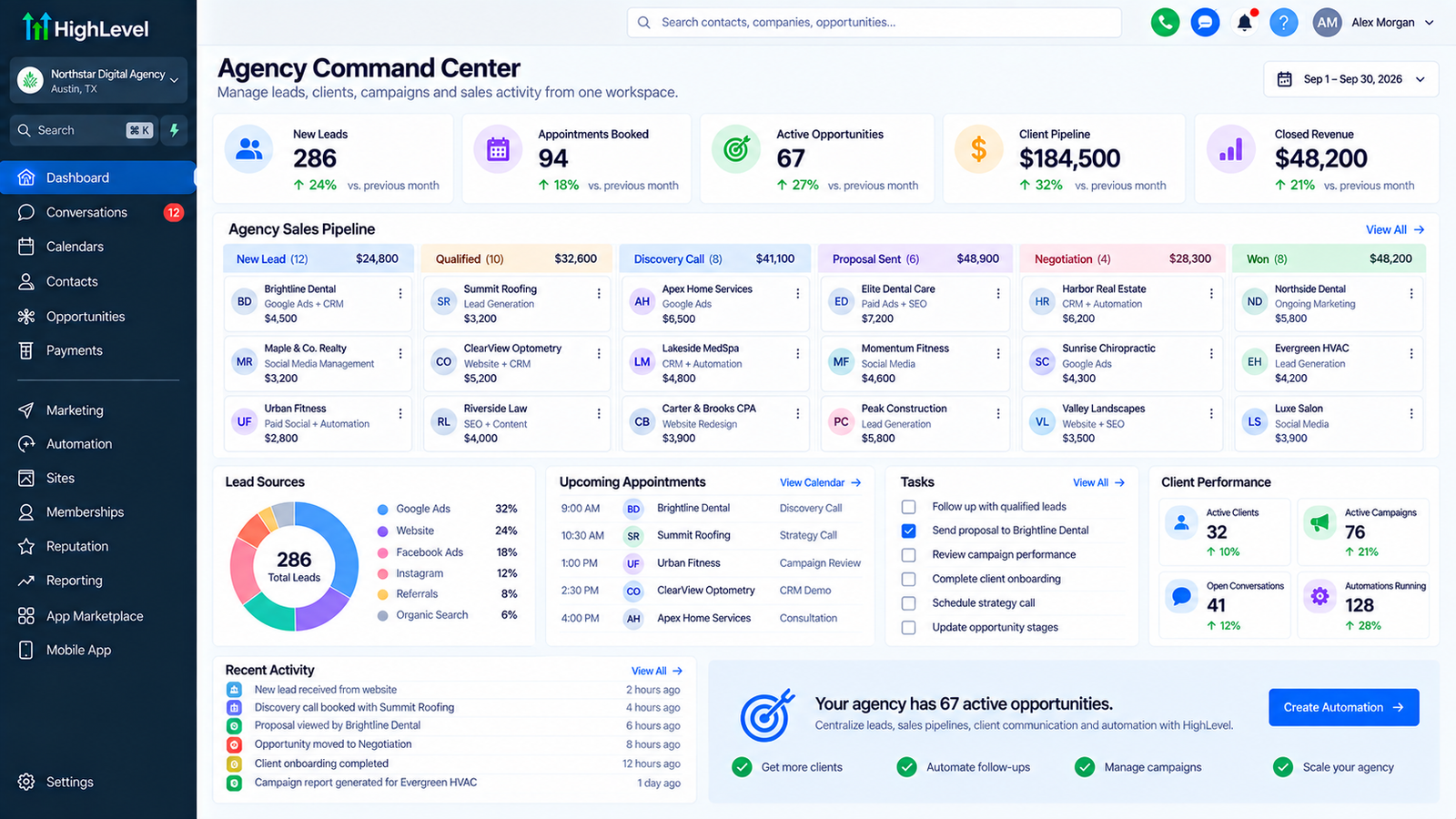
A GoHighLevel pipeline built for agencies — clients move automatically from Prospect through Proposal, Onboarding, Active, Renewal, and Expansion.
Yes. GoHighLevel is a strong platform for digital marketing agencies because it consolidates client management, campaign automation, proposal delivery, and communication into a single CRM with unlimited white-label sub-accounts — replacing 3-5 separate tools most agencies already pay for.
Short answer: GoHighLevel works as an agency operations CRM — white-labeled client portals, proposal tracking, onboarding automation, renewal triggers, and reporting in one system. It is a CRM and automation layer, not a replacement for your actual service delivery (ad management, design, dev work). See what GoHighLevel does and doesn’t replace below.
Whether it produces positive ROI depends on your client count, current churn rate, and how fragmented your current tool stack is. This guide covers the client-churn math, agency CRM setup, white-label positioning, the core automation workflows to build, multi-client governance, what it actually costs, and the exact 60-day rollout — based on systems we have configured for agencies across North America. If you’re deciding whether to DIY or hand it to an expert, our done-for-you GoHighLevel setup service covers the implementation at the end.
What’s in This Guide
- Who This Guide Is For
- The Agency Client Lifecycle & Where GHL Fits
- GoHighLevel Agency CRM Setup
- The Revenue Problem: Churn, Renewals & Missed Expansion
- White-Label Setup & Client Portal Strategy
- Core Agency Workflows (9 Automations Every Agency Needs)
- Multi-Client Governance & Admin Structure
- What GoHighLevel Does & Doesn’t Replace
- What Automation Actually Changes: Results Data
- GoHighLevel vs. Agency CRMs (HubSpot, Pipedrive, Nutshell)
- Cost, ROI & Profitability Math
- Implementation Roadmap & 60-Day Launch
- FAQ
- When GHL Is & Isn’t a Good Fit
Key Takeaways
- [Industry benchmark] The average agency loses an estimated 15-25% of clients annually to churn — applying structured renewal automation to that lifecycle can meaningfully reduce it, though the exact size of the reduction depends on your baseline and niche.
- [HAT implementation observation] At an average client lifetime value of $15,000-$50,000, a 100-client agency retaining just 5 additional clients annually through better renewal workflow adds $75,000-$250,000 to annual revenue — see the full ROI model for assumptions.
- [Verified pricing, Sept 2026] GoHighLevel’s Unlimited plan ($297/month) includes unlimited white-label sub-accounts with zero per-client fees, making it structurally cheaper than per-seat CRMs at agency scale.
- [Industry benchmark] Agencies using pre-built onboarding automation report meaningfully faster client onboarding versus fully manual setup, freeing billable capacity in the first 30 days of a new client relationship.
Who This Guide Is For
This guide is designed for:
- Agency owners managing 10-500+ clients
- Marketing managers overseeing operations at digital/creative agencies
- Agencies currently using fragmented tools (Asana + Zapier + Mailchimp + a separate CRM)
- Agencies wanting to white-label a platform for proprietary client-facing positioning
If you run a solo freelance practice, the proposal automation and client portal sections are still useful, but the white-label and multi-client governance sections assume team complexity. See our real estate lead-response model if your agency serves real estate clients specifically, or the full GoHighLevel setup guide for a general-purpose walkthrough.
The Agency Client Lifecycle & Where GHL Fits
An agency runs each client through predictable stages — GHL’s job is to automate the communication and data flow at each one.
The Six-Stage Lifecycle:
Stage 1: Prospect → Proposal
- Trigger: Inbound inquiry or outbound outreach
- GHL Role: Capture lead, assign to account manager, trigger proposal workflow
- Automation: Auto-respond, send qualification intake form, auto-schedule discovery call
Stage 2: Proposal Review → Signed Contract
- Trigger: Proposal sent
- GHL Role: Track engagement, trigger follow-up sequence
- Automation: “Proposal opened” alert to salesperson, auto-reminder before expiry
Stage 3: Onboarding → Service Delivery
- Trigger: Contract signed
- GHL Role: Coordinate handoff between sales and delivery
- Automation: Auto-send onboarding checklist, kickoff details, internal task assignments
Stage 4: Active Client → Monthly Reviews
- Trigger: Campaign running, reporting period
- GHL Role: Trigger performance reporting and review scheduling
- Automation: Auto-pull performance data, auto-generate report template
Stage 5: Renewal Decision Point
- Trigger: 90 days before contract end
- GHL Role: Identify at-risk renewals, trigger a structured business review
- Automation: Auto-send renewal brief, schedule review, escalate non-responders
Stage 6: Renewal or Expansion
- Trigger: Contract renewal or upsell opportunity
- GHL Role: Close renewal or route into expansion discovery
- Automation: Auto-generate renewal contract, auto-trigger expansion proposal workflow
The result: Every client moves predictably through six stages with zero manual reminders — and the two highest-leverage moments (renewal and expansion) are triggered automatically instead of relying on someone remembering.
GoHighLevel Agency CRM Setup
Before building automations, the CRM needs to be structured around how an agency actually runs — not GHL’s generic default setup. A proper setup covers:
- Pipeline configuration — Custom stages: Prospect, Proposal Sent, Onboarding, Active, Renewal, Expansion, Churned
- Client sub-account structure — One white-labeled sub-account per client, isolated from other clients’ data
- Custom fields — Contract value, renewal date, account manager, service package tier — the data that drives which workflow a client enters
- Role-based access — Account managers see only their assigned clients; admins see everything (see governance section)
- Conversation settings — Shared inbox per client so any team member sees the full communication history
- Reporting dashboard — Churn rate, renewal conversion, and time-to-onboard tracked by stage
This setup layer is what most DIY builds skip — they wire up a few email sequences without first structuring the sub-account architecture correctly, which becomes painful to untangle as the client count grows.
The Revenue Problem: Churn, Renewals & Missed Expansion
Leak #1: Renewal Churn (The Biggest Leak)
The math: The average agency loses an estimated 15-25% of clients annually. At $30,000 average client LTV, a 100-client agency losing 20 clients/year loses roughly $600,000 in revenue. Reducing churn even a few points through structured renewal follow-up compounds significantly over multiple years.
GHL fixes this: A 90-day pre-renewal alert triggers a structured business review workflow instead of relying on someone remembering the contract end date.
Leak #2: Expansion Blindness
The math: Agencies often don’t systematically track which clients are hitting performance milestones that signal expansion readiness — meaning upsell opportunities are found ad hoc rather than consistently.
GHL fixes this: A KPI dashboard flags clients hitting performance targets, auto-triggering an expansion conversation before the client thinks to ask for one.
Leak #3: Account Handoff Breakdown
The math: When account notes live in Slack, Gmail, and Asana instead of one system, a new team member inherits an account with no context — a common driver of preventable client frustration and churn.
GHL fixes this: A unified client record means a new account manager sees the complete history on day one.
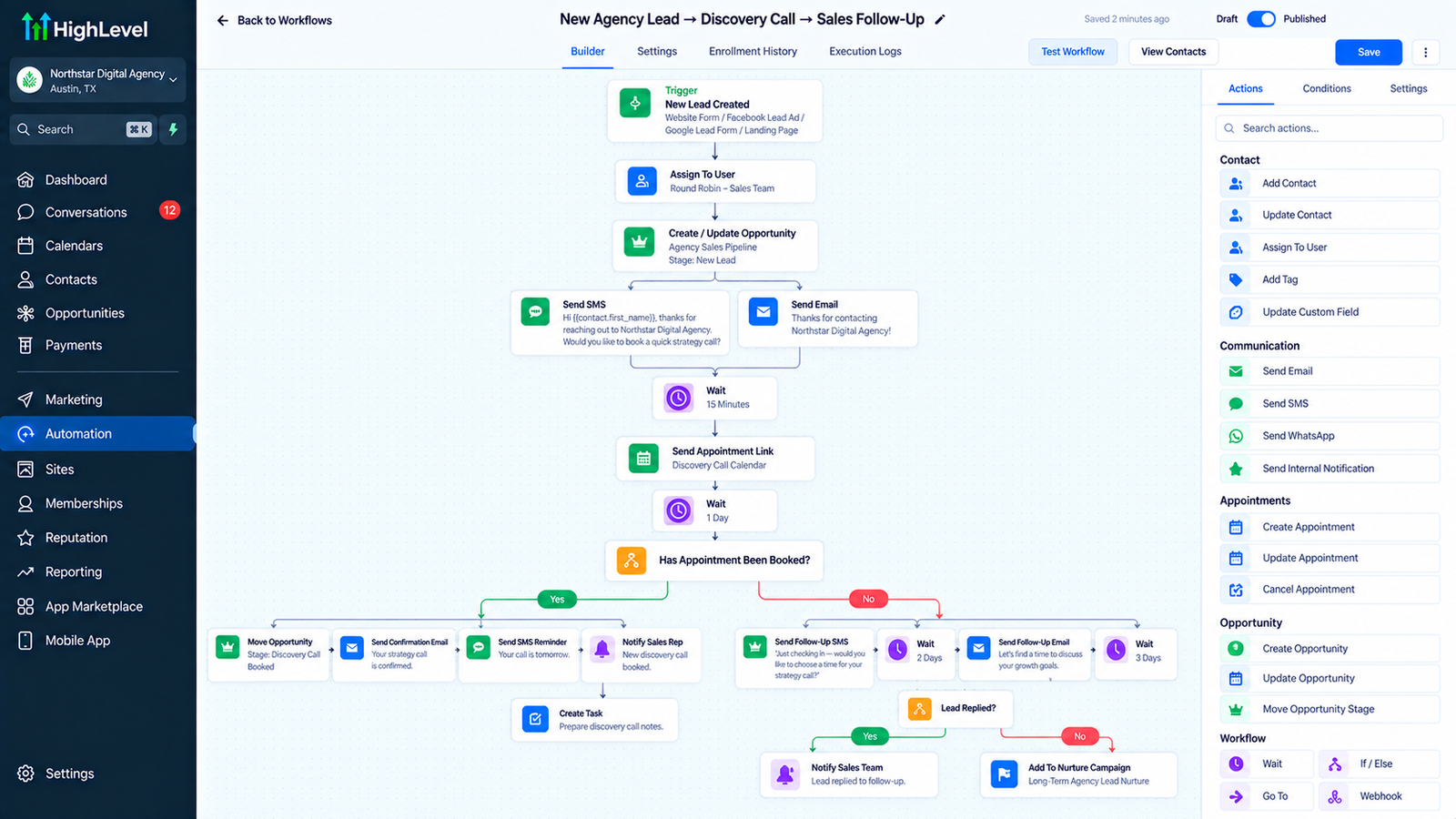
An onboarding-to-renewal workflow: a signed contract triggers onboarding tasks, monthly reporting reminders, and a 90-day renewal alert.
White-Label Setup & Client Portal Strategy
Clients want to see your brand on the CRM, not GoHighLevel’s. White-labeling positions GHL as your proprietary system:
- Custom domain — Client logs into a subdomain of your agency’s own domain, not gohighlevel.com
- Custom branding — Your logo, colors, and fonts throughout the client-facing interface
- Custom email sending — Automations send from your agency’s domain, not GHL’s
What you get: differentiation from competitors, a switching cost (the client is tied to your system, not a generic CRM), and the option to position portal access as a premium add-on service. Setup takes 1-2 hours for custom domain and branding and is included in the Unlimited plan.
Core Agency Workflows: 9 Automations Every Agency Needs
Workflow 1: Proposal & Discovery Automation
Trigger: Inbound inquiry captured in GHL
Sequence:
- Auto-respond within hours, not days
- Auto-send qualification intake form
- Auto-send discovery call availability after 24 hours if no response
Faster response improves prospect-to-call conversion
Workflow 2: Onboarding Automation
Trigger: Contract signed
Sequence:
- Auto-send onboarding checklist and brand guidelines request
- Auto-assign internal tasks: tracking setup, campaign brief, kickoff scheduling
- Auto-send kickoff meeting details 24 hours before
Reduces onboarding time and frees billable capacity
Workflow 3: Monthly Reporting Automation
Trigger: First day of month
Sequence:
- Auto-pull performance data from connected ad/analytics accounts
- Auto-generate report template with KPI highlights
- Auto-schedule the review call and notify the account manager
Saves hours per client per month on manual report building
Workflow 4: Renewal Trigger Automation
Trigger: 90 days before contract end
Sequence:
- Auto-flag client in the renewal pipeline
- Auto-send business review invite with a performance summary attached
- Auto-escalate to manager if no response by day 60
Directly targets the renewal-churn leak above
Workflow 5: Service Issue Escalation
Trigger: Client submits a support request
Sequence:
- Auto-acknowledge receipt within minutes
- Auto-categorize by urgency and route to the right team member
- Auto-follow up 24 hours after resolution to confirm satisfaction
Prevents service issues from silently becoming churn
Workflow 6: Proposal Engagement Tracking
Trigger: Proposal sent
Sequence:
- Auto-track proposal opens and time spent per section
- Auto-notify salesperson on repeat opens (buying signal)
- Auto-follow up if unopened after 3 days
Increases proposal conversion through real-time follow-up
Workflow 7: Monthly Satisfaction Pulse
Trigger: Mid-month, per active client
Sequence:
- Auto-send a brief 3-question satisfaction survey
- Auto-flag low scores for account manager review
- Auto-create an internal task to address flagged concerns
Catches churn risk 60-90 days before it becomes a lost client
Workflow 8: Expansion Trigger Automation
Trigger: Client hits a defined performance milestone
Sequence:
- Auto-flag the client as an expansion candidate
- Auto-notify the account manager with the specific milestone data
- Auto-send an expansion discovery call request to the client
Converts strong performance into additional revenue systematically
Workflow 9: Win-Back Automation (Churned Clients)
Trigger: Client contract churns
Sequence:
- Auto-send an exit interview request
- Auto-enroll in a quarterly win-back sequence (case studies, new services)
- Auto-flag if re-engagement succeeds
Recovers a share of churned clients without manual follow-up
Multi-Client Governance & Admin Structure
With multiple clients and team members, role-based access control matters:
| Role | Access |
|---|---|
| Agency Admin | All clients, all data, billing and agency-wide settings |
| Account Manager | Assigned clients only — can view/edit data, communicate, create tasks |
| Service Provider | Assigned tasks and client contact info only — no billing or other-client access |
| Client User | Their own account data only — documents, scheduling, reports |
Each client’s data is siloed — Account Manager A cannot see Client B’s records — and every interaction is logged with a full audit trail of who did what and when.
What GoHighLevel Does & Doesn’t Replace
GoHighLevel handles CRM, client communication, proposal tracking, and onboarding automation — but it doesn’t replace every system an agency runs on. Being clear about this upfront avoids the most common source of buyer confusion:
| System | Does GHL Replace It? |
|---|---|
| CRM / client pipeline management | Yes |
| Proposal tracking & follow-up automation | Yes |
| Client onboarding & renewal workflows | Yes |
| Landing pages & lead capture | Yes — built-in, unlimited |
| Ad platform management (Google/Meta Ads) | No |
| Design/creative production tools | No |
| Project management (task tracking for internal delivery work) | Not necessarily — integrates with tools like Asana via Zapier |
| Invoicing / accounting | Not necessarily — integrates with accounting tools via Zapier |
What Automation Actually Changes: Results Data
[HAT implementation observations] Aggregate patterns we see across agency GoHighLevel implementations — illustrative ranges based on client configurations, not guaranteed results. Every agency’s baseline differs:
Real client result: Queen’s Austin-based agency, serving clients nationwide, implemented an end-to-end GoHighLevel + Make.com system 3 months ago. The build automated client follow-up, quotation generation, sales call note-taking, and day-to-day team follow-up across the full sales pipeline — replacing manual work that previously required the team to track each step by hand.
GoHighLevel vs. Agency CRMs (HubSpot, Pipedrive, Nutshell)
Monthly Cost Comparison — 5-User Agency, 50 Clients
GHL shown at flat-rate Unlimited pricing (unlimited sub-accounts); Pipedrive/Nutshell/HubSpot shown at 5 seats. HubSpot Professional requires a 3-seat minimum at $890/seat.
| Feature | GoHighLevel | HubSpot Pro | Pipedrive | Nutshell |
|---|---|---|---|---|
| Base Price (5 users, 50 clients) | $297/mo flat | $2,670+/mo | $495/mo | $495/mo |
| Client Sub-Accounts | Unlimited, white-label | Not supported | Not supported | Not supported |
| Communication (SMS/Email/Call) | Built-in (usage) | Email only | Limited | Limited |
| Automation Depth | Advanced (9+ workflows) | Good | Basic | Basic |
| Landing Pages | Built-in, unlimited | Add-on | Not included | Not included |
| Best For | Agencies managing 10-500 clients | Enterprise B2B sales teams | Small sales teams | Small sales teams |
Verdict: GHL wins on consolidation for agencies specifically — white-label sub-accounts, integrated communication, and lower cost at scale. See full GoHighLevel pricing for platform cost details. HubSpot wins for complex B2B sales needing advanced attribution and enterprise reporting.
Cost, ROI & Profitability Math
What You’ll Pay
- Platform: $97 (Starter) / $297 (Unlimited) / $497 (Agency Pro) per month — most agencies with multiple clients need Unlimited for white-label sub-accounts. See full GoHighLevel pricing breakdown
- Communication (SMS/calls): $200-1,000+/month depending on client count and volume
- Implementation: DIY $0 (40-80 hours) or done-for-you $3,000-8,000
Illustrative ROI Model: 50-Client Agency
This is a scenario model built on the stated assumptions — not a forecast or guaranteed result. Your actual numbers depend on your client mix, churn baseline, and team structure.
Annual Revenue Impact Breakdown
Baseline: 100 clients, 20% annual churn, $30,000 average LTV = $600,000/year revenue at risk from churn
With structured renewal automation: Reducing churn from 20% to 10% retains 10 additional clients = +$300,000/year
Plus expansion capture: 3 additional expansion deals at $15,000 avg = +$45,000/year
Cost (Year 1): ~$17,564 (platform + communication + implementation)
Even capturing a fraction of the churn-reduction and expansion opportunity typically clears the platform cost many times over — the actual size depends entirely on your agency’s real baseline.
Implementation Roadmap & 60-Day Launch
Weeks 1-2: Audit & Setup
- Document current clients, contracts, renewal dates
- Create GHL account, configure white-label domain and branding
- Build the pipeline: Prospect → Proposal → Onboarding → Active → Renewal → Expansion
Weeks 3-4: Core Workflows (Pilot)
- Build Workflow 1: Proposal & discovery automation
- Build Workflow 2: Onboarding automation
- Build Workflow 3: Monthly reporting automation
- Test with 5 pilot clients before full rollout
Weeks 5-6: Scale to Full Client Base
- Create sub-accounts for all clients, import data
- Build Workflow 4: Renewal trigger automation
- Build Workflow 5: Service issue escalation
- Train the team on the new system
Weeks 7-8: Advanced Automation & Launch
- Build Workflow 7: Monthly satisfaction pulse
- Build Workflow 8: Expansion trigger automation
- Launch to full client base and monitor early results
FAQ
Q: Will clients be confused if we white-label GoHighLevel?
A: No. Clients see your brand, your logo, your domain. They never see “GoHighLevel” unless you tell them.
Q: Is GoHighLevel good for digital agencies?
A: Yes, especially for agencies managing 10+ clients who want white-label sub-accounts, renewal automation, and consolidated communication. It’s a weaker fit for solo freelancers with 1-3 clients.
Q: How much does GoHighLevel cost for an agency?
A: $297/month (Unlimited plan) for white-label sub-accounts, plus usage-based communication costs that scale with client count. See the full cost breakdown above.
Q: Can we still use Slack, Asana, or Zapier?
A: Yes. GHL integrates with 1000+ tools via Zapier — Slack notifications, Asana task creation, and payment processors all connect. GHL becomes the hub; other tools stay as spokes.
Q: What if a client wants to leave?
A: Their data is exportable as CSV — GHL supports data portability.
Q: Can we charge clients for portal access?
A: Some agencies position white-label GHL access as an included or premium add-on service, creating an additional switching cost and recurring revenue line.
Q: Does GoHighLevel replace our project management tool?
A: Not necessarily — GHL handles the client-facing CRM and communication layer; most agencies still use a dedicated PM tool like Asana for internal delivery task tracking, connected via Zapier.
When GHL Is & Isn’t a Good Fit
Great Fit If You:
- Manage 10+ clients
- Use 3+ separate tools for CRM, communication, and reporting today
- Lose 15%+ of clients to churn annually with no structured renewal process
- Want to white-label your platform for proprietary positioning
Poor Fit If You:
- Run a solo freelance practice with 1-3 clients
- Are fully satisfied with HubSpot and don’t need white-label sub-accounts
- Need complex enterprise attribution reporting HubSpot handles better
Get Started
Your agency runs on communication, coordination, and retention. GHL automates the operations layer so your team focuses on strategy and delivery.