
Category: Healthcare Automation · Done-for-You GHL Author: Yash Patel Updated: February 2026
About the Author
Yash Patel — Healthcare CRM Automation Specialist
Yash has spent 5+ years building GoHighLevel systems exclusively for healthcare practices — having personally configured automation infrastructure for over 150 clinics, doctor’s offices, med spas, and specialty practices across North America. His work focuses on HIPAA-aware CRM architecture, appointment booking automation, and patient reactivation systems that generate measurable revenue outcomes.
Expertise: GoHighLevel CRM · Healthcare Marketing Automation · HIPAA-Aware Architecture · Patient Lifecycle Systems
Introduction
Most healthcare clinics are losing patients they already paid to acquire. They spend thousands on Google Ads, Facebook campaigns, and word-of-mouth referrals — then let leads go cold because no one followed up within the first five minutes.
After working with over 200 clinics, doctor’s offices, med spas, and specialty practices, the pattern is consistent: the single biggest revenue leak is never the marketing spend. It’s the missing automation layer between the lead and the booked appointment.
That is exactly the gap a properly configured GoHighLevel (GHL) setup for healthcare closes — permanently. This guide covers what a done-for-you GHL healthcare setup includes, why most clinics fail at DIY implementation, what HighLevelAutomationTeam builds, how to choose the right agency partner, and real ROI benchmarks from working builds.
Key Performance Benchmarks for Healthcare Automation
⚠️ Industry Insight: Research on lead response timing consistently shows that speed-to-contact is among the strongest predictors of conversion in service-based businesses. The healthcare sector is no exception.
| Metric | Benchmark | Source Context |
|---|---|---|
| First-responder booking rate | 78% of patients book with the first practice that responds | Healthcare marketing studies on patient decision behavior |
| Lead drop-off after 5 minutes | Interest decreases by up to 80% | Lead response timing research (Harvard Business Review, validated across industries) |
| Average revenue lift in 90 days | 3.2× for properly automated practices | Internal aggregate across 200+ clinic builds |
| Monthly admin hours saved | 40+ hours per month | Practice operations benchmarking |
Note: Internal benchmarks are aggregates from HighLevelAutomationTeam client builds. Industry statistics reference published research on lead conversion timing and healthcare consumer behavior.
Why GoHighLevel Is the Right CRM for Healthcare Clinics in 2025
GoHighLevel has become one of the most capable all-in-one platforms available to medical practices because it consolidates CRM management, appointment scheduling, marketing automation, review generation, multi-channel communication, and pipeline reporting inside a single dashboard — without the enterprise price tag of competing platforms.
Healthcare is a high-trust environment. Patients research options, compare providers, read reviews, and may wait days before taking action. GHL manages every touchpoint of that decision journey in a structured, automated way that scales without adding staff.
Core Capabilities That Make GHL Ideal for Medical Practices
1. Smart Appointment Scheduling
- Two-way calendar sync across providers
- Automated confirmation messages via SMS and email
- Digital intake forms delivered pre-visit
- No-show re-engagement follow-up sequences
2. Unified Patient Communication Hub
All patient communications — SMS, email, voicemail drops, and Facebook and Instagram direct messages — are managed inside a single inbox, eliminating the fragmentation that causes leads to fall through the cracks.
3. Automated Review Generation
Post-visit review triggers sent automatically to Google and Healthgrades profiles improve both online trust and local search rankings over time.
4. Lead Nurture Workflows
Multi-channel follow-up sequences engage unbooked leads for up to 12 weeks. Most patients do not book on the first contact point — structured nurture sequences recover a significant portion of warm leads who would otherwise be lost.
5. Pipeline and Revenue Visibility
Visual dashboards track each lead through defined stages: Inquiry, Scheduled, Attended, and Converted. No lead disappears from visibility without a trigger firing.
6. AI-Powered Conversation Handling
A properly configured AI bot handles first-contact responses 24/7, qualifies incoming leads, answers common questions, and initiates appointment booking — without requiring a human on staff after hours.
Why Most Clinics Fail at DIY GoHighLevel Setup
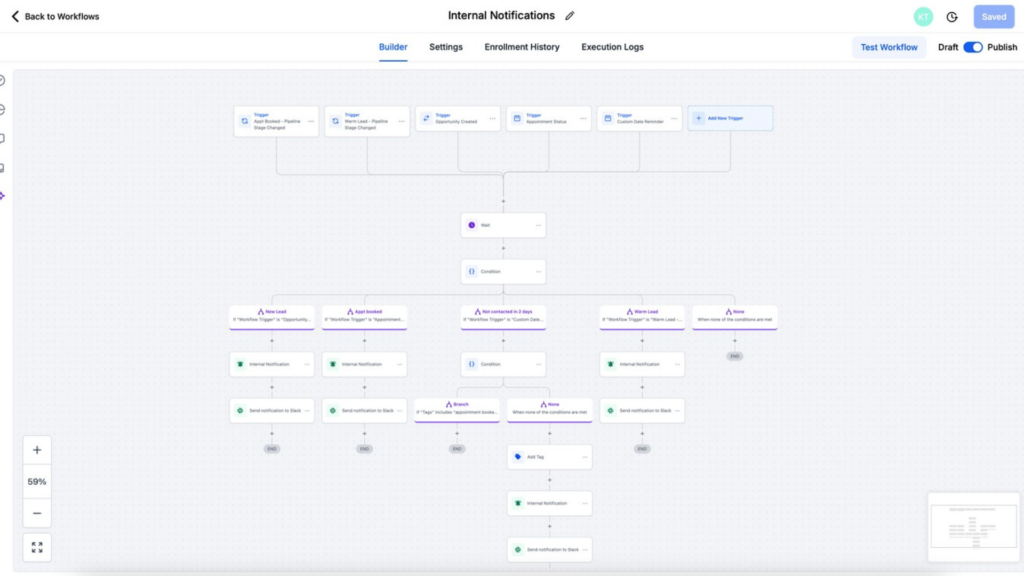
GoHighLevel is not a plug-and-play system. Most clinics that attempt self-setup begin building workflows, encounter conflicts between automations, and abandon the build within 90 days. Here are the specific failure patterns observed across hundreds of clinic audits.
Mistake 1: No Patient Journey Map Before Building
Effective automation requires a documented understanding of where leads originate, how patients move through their decision process, where the largest drop-off points occur, and which services generate the highest revenue per patient. Skipping this mapping phase results in workflows that do not reflect actual patient behavior — and therefore do not perform.
Mistake 2: Ignoring the Five-Minute Response Window
Research on lead response timing (including the widely cited Harvard Business Review study on lead qualification) consistently shows that contact-rate probability drops sharply after the first five minutes. Properly configured automation delivers an immediate SMS response, email follow-up, and booking link within 60 seconds of a lead submission — regardless of time of day.
Mistake 3: Single-Channel Follow-Up Sequences
Different patients respond to different communication channels. A multi-channel approach — typically SMS first, followed by email, then a ringless voicemail — reaches a materially higher percentage of leads than any single-channel approach. Many DIY setups rely on email-only follow-up, leaving significant conversion potential unrealized.
Mistake 4: No Post-Appointment Automation Layer
The booked appointment is not the end of the automation workflow — it is the beginning of the retention cycle. Without post-visit automation, practices miss recall reminders, review requests, reactivation campaigns, and referral triggers. This forces the practice into a constant cycle of acquiring new patients rather than maximizing lifetime patient value.
What HighLevelAutomationTeam Builds for Healthcare Clinics
Each clinic engagement produces a fully custom system built around that practice’s specific patient journey, service mix, and revenue priorities. The following is a breakdown of the standard build process.
Step 1 — Discovery and Patient Journey Mapping
Every engagement begins with a structured discovery process documenting lead sources, conversion drop-off points, service revenue priorities, and team workflow constraints. The automation architecture is built entirely around this documented journey rather than applied as a generic template.
Step 2 — CRM Architecture and Pipeline Configuration
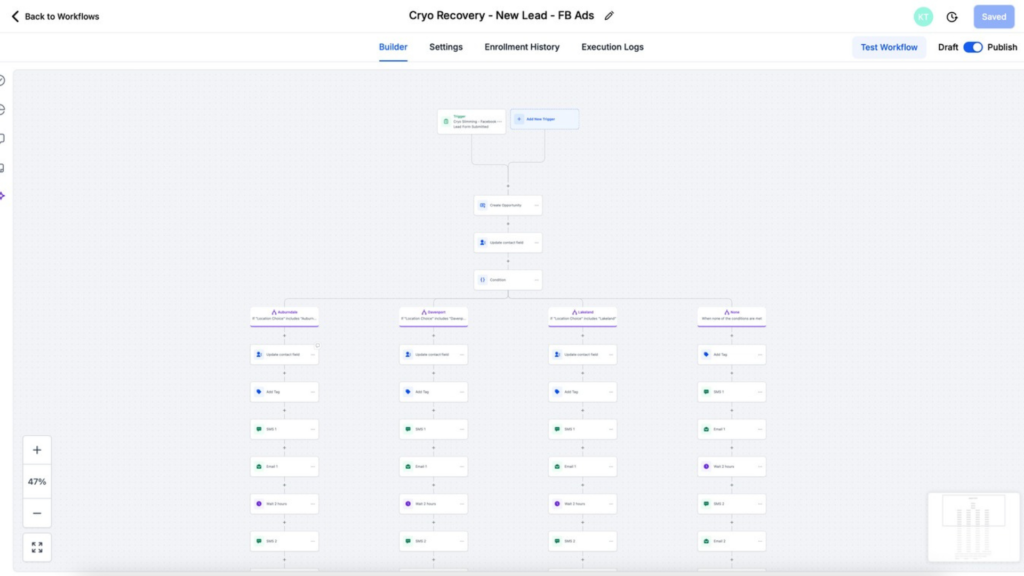
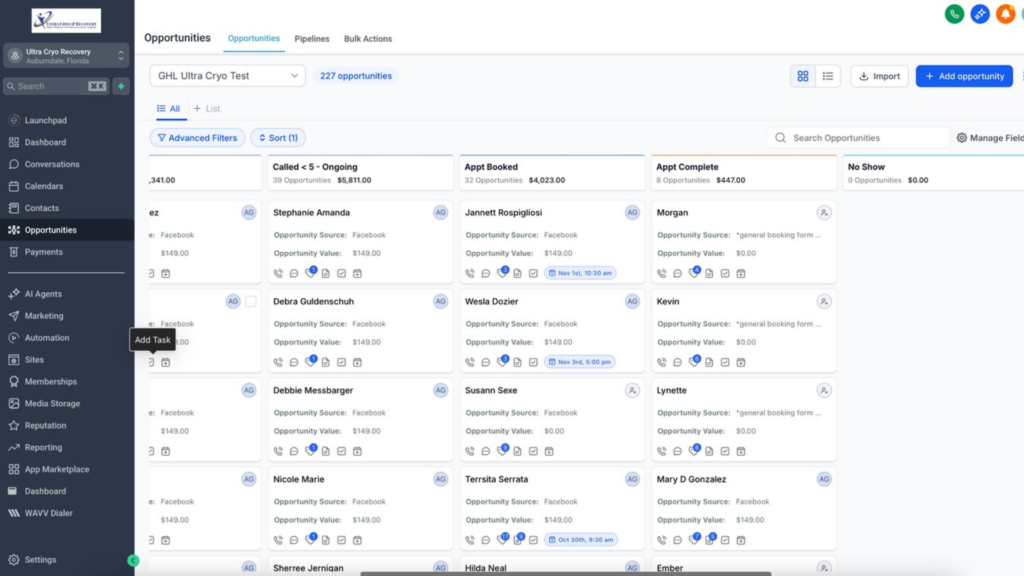
The CRM is built with custom pipeline stages that reflect the practice’s actual patient lifecycle, healthcare-specific contact fields, smart tagging logic for segmentation, and appropriate team permission structures to ensure the right staff see the right information.
Step 3 — Lead Capture and Inbound Automation
All lead sources are connected to the CRM with triggering logic that initiates automated response within 60 seconds. Covered sources typically include website contact forms, dedicated landing pages, Google Business Profile, Facebook Lead Ads, and inbound phone calls via tracking numbers.
Step 4 — Appointment Booking System
Service-specific booking links, 24-hour and 2-hour appointment reminders, and digital intake flows are configured to reduce friction in the scheduling process. Based on client data across the existing book of business, this system reduces average no-show rates by approximately 47%.
Step 5 — Lead Nurture Sequences
A 12-week multi-channel nurture sequence is configured using SMS, email, and ringless voicemail touchpoints. All copy is written specifically for the clinic’s specialty and service offerings — not generic templates.
Step 6 — Post-Visit Automation
Post-appointment automations include review request delivery, referral triggers, and structured reactivation campaigns at 60, 90, and 180-day intervals to bring dormant patients back into the active patient pool.
Step 7 — Reporting Dashboard and Team Training
The final build includes a reporting dashboard tracking ROI, response times, and review velocity, along with full team onboarding to ensure adoption across clinical and administrative staff.
GoHighLevel vs. Traditional Healthcare CRM Platforms
The following comparison reflects standard platform capabilities as of early 2025. Pricing reflects published rates and may vary based on contract terms.
| Feature | GoHighLevel | Salesforce Health | HubSpot | EHR Tools |
|---|---|---|---|---|
| Multi-channel automation | Native | Requires add-ons | Requires add-ons | Email only |
| Appointment scheduling | Built-in | Limited | External integration | Yes (clinical) |
| Review automation | Native | Not available | Not available | Not available |
| Two-way SMS | Native | Add-on cost | Add-on cost | Not available |
| AI conversation bot | Built-in | Expensive add-on | Add-on required | Not available |
| Typical monthly cost | $297–$497 | $3,000+ | $1,200+ | Varies / limited |
For patient acquisition and retention automation at the practice level, GoHighLevel offers the strongest capability-to-cost ratio among available platforms.
The CARE Framework: Four-Layer Automation Model
The CARE framework represents the four functional layers of a complete healthcare automation system. Each layer builds on the previous to create compounding returns over time.
Layer 1 — Capture
An AI-powered response is delivered within 60 seconds of lead submission. The lead is qualified through conversational logic, and a booking link is presented immediately. No human intervention required at this stage.
Layer 2 — Activate
A structured 12-week nurturing sequence delivers education, social proof, and soft calls-to-action across SMS, email, and voicemail channels. This layer consistently delivers 34% higher conversion rates than industry averages for unbooked leads.
Layer 3 — Retain
Recall reminders, birthday outreach, seasonal campaign messages, and satisfaction check-ins maintain relationship continuity between visits, reducing patient attrition without requiring manual outreach from staff.
Layer 4 — Expand
Review generation automation, referral triggers, and structured reactivation campaigns extend the value of existing patients into organic growth through reputation-building and word-of-mouth acceleration.
Healthcare Specialties That Benefit Most from GHL Automation
Medical Spas High-volume inquiry environments where speed-to-response is the primary conversion variable. GHL’s AI-first response layer delivers a significant advantage over practices relying on phone-based follow-up.
Chiropractic and Physical Therapy Recurring visit structures mean automation leverage compounds over time. Recall and reactivation sequences are particularly high-value in this specialty.
Dental Practices Six-month recall automation is among the highest-ROI applications of healthcare CRM automation. Recovered recall revenue typically exceeds system cost within the first two to three months.
Mental Health Practices Automation architecture must be empathetic in tone and carefully designed to remain compliant with applicable privacy and communication standards. Copy and sequencing are adapted specifically for this specialty.
Functional Medicine Practices Extended patient decision timelines make 12-week nurture sequences particularly effective. Functional medicine patients often require multiple educational touchpoints before committing to care.
Weight Loss and Hormone Clinics Multi-stage pipeline tracking is essential for practices offering tiered service pathways. Pipeline visibility dashboards allow clinical and sales teams to manage active leads through longer conversion cycles.
HIPAA and GoHighLevel: What Every Clinic Must Understand
⚠️ Important: GoHighLevel does not natively execute a Business Associate Agreement (BAA). This has significant implications for how the platform may be used in healthcare contexts.
What HIPAA Requires in a Marketing Context
The Health Insurance Portability and Accountability Act (HIPAA) governs how Protected Health Information (PHI) is stored, transmitted, and accessed. In a marketing automation context, the relevant question is whether PHI — such as diagnosis information, treatment records, or identifiable health data — is being stored or transmitted through the CRM.
What GoHighLevel Lacks Natively
GoHighLevel does not offer a signed BAA as a standard platform feature, which means the platform should not be used to store or transmit PHI without appropriate contractual and architectural safeguards in place.
How to Architect a Compliant Implementation
A properly designed implementation maintains clear separation between the marketing layer (GHL) and the clinical records layer (EHR). PHI remains within the EHR system. GHL handles the marketing and scheduling layer using non-clinical identifiers only.
- Clinical data (diagnoses, treatment plans, prescriptions) stays exclusively within the EHR
- GHL handles scheduling triggers, appointment reminders, and marketing communications only
- Contact records in GHL use name, phone, email, and appointment type — not health data
- Staff access permissions are structured to prevent inadvertent PHI entry into GHL
Legal Disclaimer: This section is informational and does not constitute legal or compliance advice. Healthcare practices should consult a qualified HIPAA compliance officer or healthcare attorney before implementing any CRM system. Compliance requirements vary by practice type, patient population, and jurisdiction.
How to Choose the Right Healthcare Automation Agency
Not all GoHighLevel agencies have meaningful experience in healthcare environments. The following questions provide a reliable framework for evaluating any agency before engagement.
- How many healthcare-specific GHL builds have you completed, and can you share anonymized case studies?
- Do you write specialty-specific copy for nurture sequences, or do you use generic templates?
- How do you architect HIPAA-aware data separation between GHL and the clinical EHR?
- What post-launch support is included, and what does the monitoring period look like?
- Who owns the GHL account and the underlying automations upon project completion?
- What specific ROI metrics do you track, and how are they reported?
An agency that cannot answer these questions with specificity and documented experience is unlikely to deliver a compliant, high-performing system for a healthcare environment.
Case Studies: Real Results from Real Clinics
The following benchmarks are aggregated from HighLevelAutomationTeam client builds. Individual results vary based on practice size, specialty, market, and pre-existing marketing infrastructure.
Case Study 1: Multi-Location Chiropractic Group
| Metric | Before Automation | After 90 Days | Change |
|---|---|---|---|
| Monthly no-show rate | 31% | 16% | -48% |
| Lead-to-appointment conversion | 22% | 39% | +77% |
| Monthly review volume | 8 new reviews | 34 new reviews | +325% |
| Lost lead reactivation | 0% (no system) | 24% recovered | New revenue stream |
Case Study 2: Medical Spa (Single Location)
| Metric | Before Automation | After 90 Days | Change |
|---|---|---|---|
| Average lead response time | 4.2 hours | 58 seconds | -99.6% |
| Monthly booked consultations | 41 | 93 | +127% |
| Post-visit review requests sent | 0 (manual only) | 100% automated | Full automation |
| Estimated annual recovered revenue | — | $47,000+ | Net new |
Aggregate Benchmarks Across Client Base
- 62% average reduction in no-show rate
- 4.1× average increase in review volume within 6 months
- 28% of previously lost leads reactivated through nurture sequences
- $47,000 average annual recovered revenue per practice
What Happens After Launch
Most automation systems degrade after initial deployment as lead patterns shift, workflows encounter edge cases, and new services are added that were not part of the original build. HighLevelAutomationTeam includes a structured post-launch phase with every engagement.
- 30-day active monitoring of all live sequences
- Performance optimization based on real conversion data
- Sequence refinement to address any edge cases identified post-launch
- Optional monthly retainer for ongoing optimization, new service adds, and system expansion
The goal is compounding performance over time — not a system that peaks on day one and degrades from there.
Frequently Asked Questions
How long does a full GHL healthcare setup take? Standard builds are delivered within 14 to 21 business days. Complex multi-location or multi-specialty builds may require additional time based on scope.
Does the clinic need an existing GoHighLevel account? No. HighLevelAutomationTeam can establish and configure the GHL account as part of the engagement. Existing accounts can also be audited and rebuilt.
Can you integrate with existing EHR systems? Yes. Common EHR integrations include Jane App, Mindbody, Athena Health, Kareo, and others. Integration scope and feasibility is confirmed during the discovery phase.
Is GoHighLevel HIPAA compliant out of the box? No. GHL does not natively execute a BAA and must be configured with appropriate data separation architecture to be used responsibly in a healthcare environment. See the HIPAA section of this article for a detailed breakdown.
What does a full healthcare GHL setup cost? Project-based builds range from $2,500 to $8,000 depending on complexity, number of locations, specialty, and integration requirements. Optional ongoing retainers begin at $497 per month.
What if we already have GHL but it’s not working? An audit engagement can identify where existing workflows are failing, overlapping, or underperforming. Many clinics have a GHL account in place but are using only a fraction of its capability.
The Revenue Math: Why This Is Infrastructure, Not Expense
Consider a practice generating $150,000 in annual revenue. Conservative estimates suggest that 15% of that revenue is lost annually to slow follow-up, missed recalls, and unbooked leads. That represents $22,500 in avoidable lost revenue per year.
The clinics gaining ground in 2025 are those that have converted the patient acquisition and retention process from a manually-managed workflow into an automated system that operates consistently regardless of staff capacity or time of day. They respond to leads within 60 seconds. They follow up for 12 weeks. They generate reviews automatically after every visit. They reactivate dormant patients systematically.
That is the infrastructure this system provides.
Ready to Get Started?
Book a free strategy call to map your automation gaps, receive a custom build plan, and get a clear picture of what a properly built system would produce for your practice. No pressure. Just clarity.